On believing you died during the operation

I just found this interesting paper in the medical journal Anesthesiology on fear of imminent death or the delusion that death has actually occurred, both linked to anaesthetic intoxication.

Despite our repeated explanations that she had suffered a local anesthetic-induced complication, the patient remained convinced that she had died and come back to life. This patient had been a non-practicing Christian who believed in an afterlife. She had not had any previous experience of this kind or know of others who had had. She had had no fear of death in the preoperative period.

The article notes that the delusional belief that one has died has been linked to complications with the use of lidocaine, procainamide, and procaine.

As with the drugs used in the Anesthesiology case study, all of these are local anaesthetics. They are just intended to numb a specific area, so the patient is not ‘put under’ with globally conscious altering substances.

It’s also interesting because the delusion that one has died is also known in the psychiatric literature, usually in the context of diagnoses such as schizophrenia or after brain injury.

In these cases it is known as the Cotard delusion which is usually explained, rather unsatisfactorily, as being caused by a general emotional disconnection from the world, interpreted by the patient’s faulty reasoning system as being convincing evidence that they are dead.

The case studies from the anaesthesiology literature suggest that these beliefs can be triggered in other ways, although the exact process still remains a mystery.

If you’re put off by academic journals, give this article a try. It’s well written, short and fascinating.

Link to Anesthesiology article on death delusions.

The life and times of the truth serum

I just found this fascinating photo in a 1932 book on forensic psychology in the Universidad de Antioquia’s history of medicine section. It pictures the inventor of the truth serum, Dr House, administering the drug to an arrested man in a Texas jail.

The book is called Manual de Psicolog√≠a Jur√≠dica (literally ‘manual of legal psychology’) by the pioneering forensic psychiatrist Emilio Mira y L√≥pez and is a curious mixture of psychological theory, mental tests and descriptions of what seem like strange lie-detecting contraptions.

The history of the ‘truth serum’ is recounted in a fantastic article by medical historian Alice Winter from Bulletin of the History of Medicine which describes the Dr House’s invention and the influence it had on society of the time.

Truth serum was the creation of a rural Texas physician, Robert House. House claimed that the drug scopolamine hydrobromide, which was known for erasing the knowledge of painful events, could actually be used to extract intact information. His announcement was seized upon by journalists, police, and forensic scientists as heralding a potentially transformative new technology, and was just as robustly rejected by the legal community.

Scopolamine’s identity as an extractor of “truth” was indebted to certain earlier conventions‚Äînotably, research into altered psychic states such as mesmerism and hypnotism, which sometimes were said to create a confessional state. Scopolamine, in turn, created the shoes that other chemical agents would come to fill when, later in the decade and in the 1930s, the new barbiturates sodium amytal and sodium pentothal were said to have the potential to extract “truthful” memories.

These drugs largely act by reducing inhibition, with the hope that the person will speak more freely, but they have never been found to reliably make anyone more truthful.

Alice Winter was also recently interviewed on SciAm’s Mind Matters blog, in light of rumours that one of the men involved in the Mumbai attacks had been subjected to interrogation under ‘truth serum’.

Link to Winter’s article The Making of ‘Truth Serum’.
Link to ‘What is truth serum?’ from SciAm.

Love is ye drug

Today’s Nature has a fascinating letter from ecologist Joan Ehrenfeld who notes that Shakespeare describes how potions made from certain psychoactive plants were used to encourage reluctant lovers in one of his most famous plays.

Ehrenfeld is riffing on a recent Nature feature article that discussed the neuroscience of love, which seems to have been made open-access.

In his Essay ‘Love: neuroscience reveals all’ (Nature 457, 148; 2009), Larry Young claims that the biochemical understanding of love is not poetry. But at least one poet, namely William Shakespeare, foretold the application of drugs to manipulate the brain systems associated with pair bonding.

In A Midsummer Night’s Dream, Oberon maintains that topical applications of the juice of the wild pansy (Viola tricolor, called ‘love-in-idleness’ in the play) “Will make or man or woman madly dote Upon the next live creature that it sees” (Act 2, Scene 1). The potion proves highly effective, supplying much of the humour in the play as Titania falls in love with the donkey-headed Bottom. Shakespeare also suggests that other substances from “Dian’s bud” ‚Äî variously identified as a species of wormwood (Artemisia spp.) or chaste tree (Vitex agnus-castus, a species not native to England but long known for its anti-libidinal properties) ‚Äî could reverse the neurobiological results of the pansy. Perhaps poets have something to teach us about neurobiology and love after all.

Link to letter in Nature.
Link to Nature article ‘Being Human: Love: Neuroscience reveals all’.

Engraved brains

Neurophilosophy has just found some beautiful neuroanatomical engravings from an 1823 book called The Anatomy of the Brain, Explained in a Series of Engravings by the pioneering brain researcher Sir Charles Bell.

Those with a slightly medical tendency may know his name from Bell’s palsy, a facial muscle paralysis that usually affects one side, and is caused by damage to cranial nerve VII.

We have discussed Bell before on Mind Hacks, when we noted that he learnt his anatomy at a London strip club – although strictly speaking, he studied at a London anatomy school which is now one of the most famous strip clubs in London.

Neurophilosophy has some more of the fantastic engravings and recounts some of the background to the book and Bell’s work.

And if you’ve seen all of them, you may want to check out another great Neurophilosophy post on a intriguing brain scanning study that suggests that the visual cortex is used as storage during working memory for visual images.

Link to Neurophilosophy on antique brain engravings.

Car crash over before consciousness kicks in

This is a fascinating run down of an ‘anatomy of a crash’ from Australian car magazine Drive suggesting that the accident can be over before we’re even consciously aware of it happening.

This is a reconstruction of a crash involving a stationary Ford Falcon XT sedan being struck in the driver’s door by another vehicle travelling at 50 km/h.

0 milliseconds – An external object touches the driver’s door.

1 ms – The car’s door pressure sensor detects a pressure wave.

2 ms – An acceleration sensor in the C-pillar behind the rear door also detects a crash event.

2.5 ms – A sensor in the car’s centre detects crash vibrations.

5 ms – Car’s crash computer checks for insignificant crash events, such as a shopping trolley impact or incidental contact. It is still working out the severity of the crash. Door intrusion structure begins to absorb energy.

6.5 ms – Door pressure sensor registers peak pressures.

7 ms – Crash computer confirms a serious crash and calculates its actions.

8 ms – Computer sends a “fire” signal to side airbag. Meanwhile, B-pillar begins to crumple inwards and energy begins to transfer into cross-car load path beneath the occupant.

8.5 ms – Side airbag system fires.

15 ms – Roof begins to absorb part of the impact. Airbag bursts through seat foam and begins to fill.

17 ms – Cross-car load path and structure under rear seat reach maximum load. Airbag covers occupant’s chest and begins to push the shoulder away from impact zone.

20 ms – Door and B-pillar begin to push on front seat. Airbag begins to push occupant’s chest away from the impact.

27 ms – Impact velocity has halved from 50 km/h to 23.5 km/h. A “pusher block” in the seat moves occupant’s pelvis away from impact zone. Airbag starts controlled deflation.

30 ms – The Falcon has absorbed all crash energy. Airbag remains in place. For a brief moment, occupant experiences maximum force equal to 12 times the force of gravity.

45 ms – Occupant and airbag move together with deforming side structure.

50 ms – Crash computer unlocks car’s doors. Passenger safety cell begins to rebound, pushing doors away from occupant.

70 ms – Airbag continues to deflate. Occupant moves back towards middle of car.

Engineers classify crash as “complete”.

150-300 ms – Occupant becomes aware of collision.

The video of the crash test, from which is the above is taken, is also available online.

As you can see, it’s a lab-based crash test and so doesn’t capture the messiness of many real world impacts.

I checked out their figure for conscious awareness kicking in at 150-300ms and it seems to be accurate and mostly taken from the work of neuroscientist Benjamin Libet.

There’s a good 2004 review article from the Archives of Neurology that actually cites 300ms as the start of conscious awareness, some other reviews cite 200ms as a ‘rule of thumb’ figure.

Link to Drive on ‘Anatomy of a Crash’ (<a href="http://www.sentientdevelopments.com/2009/02/will-you-perceive-event-that-kills-you.html
“>via Sentient Developments).
Link to paper on ‘Neuronal Mechanisms of Conscious Awareness’.

Sleep and psychopathology

New Scientist has a fascinating article on sleep and mental illness. While it’s long been known that mental illness can disrupt sleep the article discusses the much less explored connection where loss of sleep might trigger symptoms of mental illness in some.

Until recently, however, the assumption that poor sleep was a symptom rather than a cause of mental illness was so strong that nobody questioned it. “It was just so easy to say about a patient, well, he’s depressed or schizophrenic, of course he’s not sleeping well – and never to ask whether there could be a causal relationship the other way,” says Robert Stickgold, a sleep researcher at Harvard University. Even when studies did seem to point in the other direction, the findings were largely overlooked, he says.

Scientifically, sleep and mental illness have been long linked. Theories of bipolar disorder as a disruption to circadian rhythms have been kicking round for years and treatments that reduce disruption to sleep routines are known to have a therapeutic effect.

The NewSci article reviews various studies that suggest sleep problems can increase risk for mental illness, but it doesn’t mention an equally interesting link.

We also know that sleep deprivation can help otherwise untreatable mood disorders. For example, missing a night’s sleep can be used as a treatment in depression.

Link to article ‘Are bad sleeping habits driving us mad?’.

Why smokers blunt their caffeine hit

Image by Flickr user sheeshoo. Click for sourceI was just reading an interesting paper on the interaction between antipsychotic drugs, caffeine and smoking and I found this interesting snippet on how smokers need to take in three to four times more caffeine than non-smokers to get the same effect, owing to the fact that by products of increases enzymes in the liver which break-down caffeine.

Byproducts of tobacco smoking, particularly the polycyclic aromatic hydrocarbons, are metabolic inducers. These byproducts are inducers of the [liver enzyme] cytochrome P450 isoenzyme 1A2 (CYP1A2) and of the less understood UDP-glucuronosyltransferases (UGTs).The metabolic inductive effects are not specific to tobacco smoking; they can also be expected from marijuana smoking.

Because inducers require the synthesis of new enzymes, several weeks are usually needed before the maximum effects of inducers are seen. Inducers’ effects may take a few weeks to disappear as well….

Additional pharmacologic support of the relevance of smoking’s inductive effects comes from caffeine intake studies. Caffeine, a drug that is more than 90 percent dependent on CYP1A2 for its metabolism and that is widely used in the United States, can exemplify smoking’s effects on drug metabolism.

The C/D [concentration-dose ratio] of caffeine appears to be threefold to fourfold as high among nonsmokers compared with smokers. This higher ratio means that smokers need three to four times the caffeine “dosage” as nonsmokers on average to get the same plasma caffeine levels.

It turns out that two antipsychotic drugs, olanzapine and clozapine, are also broken down by the same enzyme, so smoking will reduce the effect of these drugs.

Hence smokers need larger doses to have the same effect, and patients on these drugs who give up smoking might find a sudden increase in side effects if the dose isn’t dropped.

We tend to think of the effect of psychotropic drugs as happening in the brain but drug metabolism happens all over the body with the liver and kidneys being particularly important and having a profound impact on the effect of the compound.

Link to ‘Atypical Antipsychotic Dosing: The Effect of Smoking and Caffeine’.

It was planted on me

I have discovered that there is small but budding group of cognitive scientists who study the psychological impact of indoor plants.

For example, here is a study on the effects of an indoor plant on creativity and mood from the Scandinavian Journal of Psychology.

Effects of an indoor plant on creative task performance and mood.

Shibata S, Suzuki N.

Scandinavian Journal of Psychology. 2004 Nov;45(5):373-81.

In this study, we investigated the effect of an indoor plant on task performance and on mood. Three room arrangements were used as independent variables: a room with (1) a plant, or (2) a magazine rack with magazines placed in front of the participants, or (3) a room with neither of these objects.

Undergraduate students (M= 35, F= 55) performed a task of associating up to 30 words with each of 20 specified words in a room with one of the three room arrangements. Task performance scores showed that female participants performed better in view of the plant in comparison to the magazine rack (p < 0.05).

Moreover, mood was better with the plant or the magazine rack in the room compared to the no object condition (p < 0.05). However, the difference in task performance was highly influenced by the evaluation about the plant or the magazine rack. It is suggested that the compatibility between task demand and the environment is an important factor in facilitating task performances.

Somehow, I feel my world view has not actually changed after reading that study.

But wait, there are also published research studies on:

Effects of the foliage plant on task performance and mood.

Effects of indoor plants on task performance and mood: a comparison between natural and imitated plants.

Influence of limitedly visible leafy indoor plants on the psychology, behavior, and health of students at a junior high school in Taiwan.

The association between indoor plants, stress, productivity and sick leave in office workers.

And someone even did their PhD on “Randomized clinical trials evaluating therapeutic influences of ornamental indoor plants in hospital rooms on health outcomes of patients recovering from surgery”.

Link to PubMed entry for Scandinavian Journal of Psychology study.

Christina the Astonishing and the saints of epilepsy

I’ve just read a fascinating article on the wonderfully named Christina the Astonishing, a 12th century saint who died during an epileptic seizure, rose from the ‘dead’, and according to some accounts, levitated to the roof of the church.

The paper, published in the medical journal Neurology, discusses her case because while various people have suggested that the supernatural experiences of the saints can be nowadays explained as epilepsy, Christina was thought to both be holy and have epilepsy by her contemporaries.

However, the paper begins with this fascinating bit about the history of the relationship between saints and the long mythologised condition:

In 1930, Kanner catalogued no less than 37 saints associated with “the falling sickness” and the eventful lives of many of these are illuminated in Murphy’s excellent paper “The saints of epilepsy.” While many made their name casting out demons and curing epilepsy, Pope Benedict XIV tightened up the rules relating to miraculous cures of seizures in 1743, particularly in relation to a relapse of the condition. No one has been canonized on the basis of a miraculous cure of epilepsy since.

Other saints have a more oblique connection to the condition. For example, St. Albanaus of Mainz (400 AD) was decapitated and the subsequent writhing of his headless body apparently resembled a convulsion, hence his connection. St. Sebastian, who survived being shot by arrows only to be later clubbed to death, is invoked as his initial recovery from near death represents the recovery from a seizure, which at first may seem fatal.

The three wise men of nativity fame, who bestowed gifts on the infant Christ, are also sometimes invoked against epilepsy as they “fell down” before the infant when they found him. In the 14th century, it was thought to be beneficial to whisper the names of these saintly wise men into the ears of people as they convulsed to stop the seizure.

A number of the saints of epilepsy are thought to have suffered seizures themselves, including those from the very highest echelons — see St. Paul. While these diagnoses remain speculative and can often only be inferred from minimal fragments of information, some have gone to considerable lengths to examine their hypotheses, including the investigation of the original court manuscripts in the case of St. Joan of Arc and the examination of a 600-year-old skull in the case of St. Birgitta.

Christina’s case is fascinating in itself and the article is well worth a read.

Link to article.
Link to PubMed entry for same.

Pioneers of psychology, in their own words

The Wellcome History of Medicine Centre has interviewed some of the UK’s cognitive science elders about the early days of neuropsychology and psychiatry research and have put all the video clips online.

The interviews are a wonderful insight into the earliest days of cognitive science research which are only hampered by their annoying presentation, so I’ve created YouTube playlists so you can just sit down and just watch each of the interviews from end-to-end.

Here they are:

Elizabeth Warrington was one of the pioneers of clinical and cognitive neuropsychology in the 60s and 70s and defined much of the field as we know it today. She was working at a time when it was rare for women to be working in medical research, let alone neuroscience.

Michael Rutter was one of the founders of child psychiatry and had a huge influence on the development of psychiatric epidemiology.

Richard Gregory is a highly influential cognitive psychologist who is famous for his work on visual perception and top-down (meaning-induced) influences on what we perceive.

Uta Frith is one of the world’s foremost autism researchers and has been involved in child neuropsychology research since the 1960s.

All of the interviewees have been working for over 50 years, have been founders of their field, and are still involved in research.

Elizabeth Warrington is a personal hero of mine. She not only made some of the foundational discoveries in neuropsychology, but also was one of the creators of many of the assessment methods and techniques we use both for assessing the extent of brain injury and the understanding of what brain damage can tell us about normal brain function.

Actually, I have the minor honour of being Elizabeth Warrington’s neuropsychological ‘grand child’, as I learnt a huge amount working with neuropsychologist Pat McKenna (another one of my personal heroes), who was one of the first people who was trained by Warrington.

A minor connection but one I am proud of, and I’m sure you can see why when you hear her discuss her work in the interview.

The other interviews are also thoroughly engrossing and are like being told stories of times past by people with wisdom of experience behind them.

Weaving a history of psychiatry from states of mind

BBC Radio 4 have just concluded a fantastic five part radio series called States of Mind on the history of psychiatry in the UK since the 1950s, covering the death of the asylum, to the age of Prozac, to visions of the future.

It’s produced and presented by the fantastic Claudia Hammond and weaves together historical research, commentary from researchers and the personal stories of patients and staff who have memories of treatment through the last 60 years.

Although it specifically focuses on the UK, in many ways it reflects the history of mental health in many parts of the world owing to the fact that Britain has tended to be a leader in both psychiatric treatment and radical views of mental health.

The five parts, all of which have the streamed audio available online, are:

Total Institution
Altered States
Community Care?
Happiness in a Pill?
Which Way Now?

I was altered to the series by the increasingly excellent Frontier Psychiatrist blog which is also well worth checking out.

Link to States of Mind page.

The hashish inspired art of Jean-Martin Charcot

While searching for material on the famous 19th Century French neurologist Jean-Martin Charcot, I noticed that a number of online art shops sell drawings he did, apparently while under the influence of hashish – so I’ve been trying to find out more.

charcot_hashish.jpg

The strip above is only part of the image, as despite the fact that it is now in the public domain, most of the online sources deliberately obscure it, presumably in an attempt to get you to buy their posters while pissing off potential customers at the same time.

However, it seems that the picture is likely to be genuine. This is from a book on Charcot’s life where a contemporary recounts their hashish smoking escapades:

As soon as he was under the influence of the narcotic, a tumult of phantasmogoric visions flashed across his mind. The entire page was covered with drawings: prodigious dragons, grimacing monsters, incoherent personages who were superimposed on each other and who were intertwined and twisted in a fabulous whirlpool bringing to mind the apocalyptic visions of Van Bosh and Jacques Callot.

A 2004 article in the medical journal European Neurology discussed his lifelong interest in art and drawing, and contains a sketch of a scene from Hell also apparently created while stoned.

If anyone does know of a high quality online source of these drawings online, do let me know, as I’d particularly love to see the larger image in its full glorious detail.

Link to European Neurology on ‘Charcot and Art: From a Hobby to Science’.
Link to PubMed entry for same.

Literature and psychiatry

This month’s British Journal of Psychiatry has another one of its fantastic ‘psychiatry in 100 words’ series, with this month’s column focusing on literature.

The short piece is by psychiatrist Femi Oyebode who is the author of a recent book (pictured on the left) on the subject that covers everything from literary accounts of drug abuse to the use of narrative in fictional accounts of mental illness.

Literature and psychiatry — in 100 words

Reading works of fiction and attending to the language, the dialogue, the mood is like listening to patients. In both activities, we enter into other worlds, grasp something about the inner life of characters whose motivations may be unlike our own. D. H. Lawrence referring to this aspect of the novel wrote: `It can inform and lead into new places the flow of our sympathetic consciousness, and it can lead our sympathy away in recoil from things gone dead. Therefore the novel, properly handled, can reveal the most secret places of life’. Is this not also, partly, the task of psychiatry?

Link to ‘Literature and psychiatry ‚Äî in 100 words’.
Link to details of ‘Mindreadings: Literature and Psychiatry’ book.

Shattered delusions

I’ve just found a fascinating article in the History of Psychiatry about a type of delusion that was widely reported in the 15th to 17th centuries but rarely occurs in modern times. The reports were of patients who believed that they were made of glass and thought they might shatter if they suffered even the lightest of knocks.

In some of the more unusual forms, people struck with this form of madness might even consider themselves to be an oil lamp, a drinking vessel or even trapped in glass bottle.

The belief could even be specific to certain parts of the body:

Reports of glass bones, arms, and legs appeared much later, but Early Modern accounts were particularly rich in allusions to glass hearts/chests, and fragile heads. Tommaso Garzoni, an Italian monk,wrote a series of character sketches of mentally-disturbed people in 1586. In one of these cameos, drawn from Galen, the fragile delusion presents as a man who thought that his body consisted of only a large head, which he protected from injury by avoiding all contact with his fellows.

The delusion was reported in medical and the proto-scientific literature of the time, but also shows up in plays and literature.

Reportedly, one famous sufferer was King Charles VI of France, who allegedly refused to allow people to touch him, and wore reinforced clothing to protect himself.

While we tend to be most interested in how new delusional themes arise in response to cultural developments, we pay much less attention about delusions which were once common but now rarely occur.

This is a lovely example of a very well researched look at the history of no-longer popular delusions.

It’s also worth noting that Wikipedia has a page on the delusion where someone has briefly summarised some of the main points of the article.

Link to ‘Reflection of the Glass Delusion of Europe’.
Link to DOI entry for same.
Link to glass delusion page on Wikipedia.

Complex beginnings

The term ‘complex’, used to refer to a mental illness or psychological hang-up, has become so common as to have entered everyday language (e.g. ‘he has an inferiority complex’) but I only just recently found out about the origin of the concept.

The following is from the epic and endlessly fascinating book The Discovery of the Unconscious by Henri Ellenberger, where he discusses the use of the ‘word association test’ in early 1900s psychiatry.

The story takes us through some of the most important figures in the history of 19th and 20th century mind science. From p691:

The test consisted of enunciating to a subject a succession of carefully chosen words; to each of them the subject had to respond with the first word that occurred to him; the reaction time was exactly measured…

It was invented by Galton, who showed how it could be used to explore the hidden recesses of the mind. It was taken over and perfected by Wundt, who attempted to experimentally establish the laws of the association of ideas.

Then Aschaffenberg and Kraepelin introduced the distinction of inner and outer associations; the former are associations according to meaning, the latter according to forms of speech and sound; they could also be called semantic and verbal associations.

Kraepelin showed that fatigue caused a gradual shift toward a greater proportion of verbal associations. Similar effects were observed in fever and alcoholic intoxication. The same authors compared the results of the word association test in various mental conditions.

Then a new path was opened by Ziehen who found that the reaction time was was longer when the stimulus word was to something unpleasant to the subject. Sometimes, by picking out several delayed responses, one could relate them to a common underlying representation that Ziehen called gefühlsbetonter Vorstellungskomplex (emotionally charged complex of representations), or simply a complex.

Carl Jung later used the test extensively as a more rigorous alternative to Freudian free association and found some interesting results.

In women, erotic complexes were in the foreground with complexes related to the family and dwelling, pregnancy, children and marital situation; in older women he detected complexes showing regrets about former lovers. In men, complexes of ambition, money and striving to succeed came before erotic complexes.

The description comes from a chapter about Carl Jung, who was originally a psychoanalyst but broke away from Freud’s system and developed his own.

Freud’s theories, with only a few exceptions, just seem to get loopier the more you read them. Jung is interesting because on the surface his ideas seem quite barmy but are often remarkably sensible when you understand them in more detail.

Despite his interest in everything from ghosts to UFOs, he always maintained these were essentially psychological phenomena that reflected important aspects of our collective culture and subconcious mind.

For example, I always thought his concept of the ‘collective unconscious’ was supposed to be some sort of semi-mystical psychic connection, but in fact, he was just describing much of what is now a premise of evolutionary psychology.

Namely, that by nature of being human, we may share some inherited psychological structures, common symbols or ideas – such as what ‘motherhood’ entails – that can be seen in both common behaviours and in myths and stories throughout history.

Simulating hysteria for fun and profit

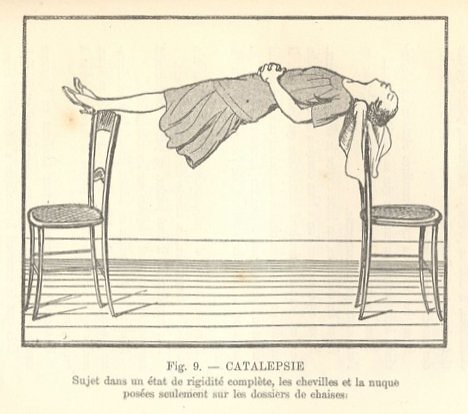
I’ve just found pages from a 1941 French hypnotism manual on the (tastefully NSFW) Au carrefour √©trange blog that has some wonderful illustrations of hypnotism ‘in action’.

A few are particularly curious because they seem to be directly mimicking famous images of hysteria from the 1800s.

Hysteria is the presence of neurological symptoms without any detectable neurological damage that could account for it (see previous) and the top image on the right is taken from a late 1800s book ‘Lectures on the Diseases of the Nervous System’ by Jean-Martin Charcot who argued that patients with hysterical epilepsy can show this type of body posture he called the ‘Grande Hysterie Full Arch’.

It’s an iconic image and can be seen to the left of the famous painting entitled ‘A Clinical Lesson with Doctor Charcot at the Salp√™tri√®re’ by Andr√© Brouillet that Freud had hung above his couch. You can still see it there in fact, in Freud’s old house, now the Freud Museum in London.

The image below is taken from the 1941 French hypnotism manual. In fact, all the images of the woman mimic Charcot’s famous photos or drawings of hysterical patients.

For example, here’s the Charcot original of a woman between two chairs, and here’s the image from the manuel d’hypnotisme.

Unfortunately, the Au carrefour √©trange website doesn’t have text from the book, but the images suggest that it is encouraging practitioners to simulate these famous poses.

Interestingly, Charcot was the first to suggest that hypnotism and hysteria may rely on similar neurological and psychological processes owing to the fact that it is possible to temporarily simulate hysteria with hypnosis.

Over 100 years later, there is growing evidence that this is the case, as neuroimaging studies have shown that hysterial paralysis and hypnotically-induced paralysis activate remarkably similar brain areas.

However, his classifications of the different body postures of hysteria are now thought to useless, and likely caused by Charcot’s own suggestions to his patients.

The pages from the hypnotism book are on a site with tasteful but NSFW images, so be cautious at work, or be ready with your excuse about a historical interest in Charcot.

UPDATE: The same blog has images from another French hypnotism book called Nouveau cours pratique d’hypnotisme et de suggestion from 1929. Dig that cover!

Link to pages of ‘Manuel pratique d’hypnotisme’ (via MorbidAnatomy).