Moses extreme reactions

Photo by Flickr user mac steve. Click for sourceSome statistical tests with wonderful names. From SPSS, one of the standard data analysis software packages used by psychologists.

Kendall’s W
Cochran’s Q
LSD post-hoc
Two-step cluster
Fisher’s exact test
Wald-Wolfowitz runs
Moses extreme reactions

UPDATE: Thanks to everyone who has added to our list of wonderfully named statistical tests used by psychologists. Grabbed from the comments, they include:

Tukey’s Honest Significant Difference
Smoothed Bootstrap
Jackknife Variance
Roy’s Largest Root

A classification of royal stalkers

A fascinating new study on the types of people who stalk or harass the British Royal Family has just been published online by the journal Psychological Medicine.

A group of forensic psychologists examined, by hand, twenty thousand files held by SO14, the Metropolitan Police Service’s Royalty Protection unit, to study people who had made inappropriate approaches or communications with the British royals.

This is the classification of harassers and stalkers by motivation:

Delusions of Royal Identity (i.e. pretenders to the throne or to royal kinship). This was the largest group, accounting for 67 cases (26.9%). Seventeen (6.8%) expressed delusional beliefs that they were the true sovereign. This group often wrote lengthy letters accompanied by family trees and multiple annotated documents in support of their claims. Claims of kinship to the sovereign were made by a further 50 (20.1% of the whole sample). There was often evidence in their writings of complex delusional systems.

Amity Seekers were the 41 (16.5%) subjects who offered their friendship and advice, which they expected to be taken, apparently oblivious to the unrealistic nature of their endeavour.

The Intimacy Seekers consisted of 30 (12%) individuals. Fourteen (5.6%) had clearly erotomanic preoccupations, 10 of whom were male. All expressed the conviction that they were loved by or already married to their royal target. Those who were infatuated but not clearly erotomanic (16; 6.4%) usually wished to express their love or offer their hand in marriage to a royal. They understood that the royal personage did not yet love them or even know of their existence, but they still expressed confidence that they would succeed in their suit.

Sanctuary and Help Seekers made up 22 (8.8%) of the sample and were asking for royal assistance with personal adversity or royal protection from supposed persecutors.

The Royally Persecuted were a small group of only eight (3.2%) subjects, who claimed to be victims of organized persecution orchestrated by a member of the Royal Family.

Counsellors who, though similar in some ways to the Amity Seekers, were a group of 28 (11.2%) individuals who saw it as their role to offer advice and opinions to the Royal Family on how they should live their lives and respond to political situations.

Querulants formed a group of 16 (6.4%) people who were pursuing a highly personalized quest for justice and vindication. They were seeking royal assistance with their claims, or complaining of royal indifference to their cause.

The Chaotic comprised a group of 37 cases (14.9%), where no clear motivation could be assigned because their writings and/or their statements to police were so difficult to follow or understand. It was not that there was insufficient information to assign another category. Rather, their thought processes and behaviour were so disturbed as to make a singularity of purpose unlikely.

The most famous stalker of the British Royal Family was probably Klaus Wagner, a German ex-doctor who believed that the Queen was the beast prophesised in Revelations and that Princess Diana was being persecuted by the Royal Family.

He was eventually sent to jail for stalking Diana, and apparently remained on his quest to defeat the ‘Elizardbeast’ until his death in 2007.

Wagner came to prominence in a controversial UK TV documentary called I’m Your Number One Fan that featured three stalkers of high profile celebrities. It used to be available on the net but has since disappeared, although occasionally turns up on torrent servers.

Interestingly, one of the first cases of what we now call erotomania or de Cl√©rambault’s syndrome, the delusional belief that another person – usually of higher status – is in love with you, featured the British Royal Family.

de Clérambault described the case of a 53 year old French woman who believed King George V was in love with her and would interpret twitches in the curtains of Buckingham Palace as secret love signals from the monarch.

Link to study.
Link to PubMed entry for same.

Head first into brain scanner technology

Nature has a great open-access article on the technology of MRI neuroimaging, responsible for the majority of ‘brain scans’ that are used in medical examinations, scientific studies and media reports.

Understanding the technology of MRI scanners is not just of interest to medtech geeks, it is essential to be able to interpret and design brain imaging studies.

We tend to think that all brain scanners do the same thing, but comparing raw data across just two scanners can be a big problem.

Imagine if there were two different ways of measuring the layout of a room, one involving placing paper squares on the floor and another by tying string between all the objects. The conclusions might be similar but trying to merge all the raw results into one big data set would be a pain.

A similar problem affects researchers using brain scanners, because manufacturers may use different magnetic pulse sequences, different coils, different processing software and have to tweak the settings for each individual installation.

As a consequence, various studies are now developing ways (mainly data processing algorithms) to ensure that even relatively simple procedures, like structural scans, can be reliably compared across different scanners.

But even using just one scanner, it’s important to know what the technology is doing because this determines what aspects of the body’s physiology it measures.

The Nature article focuses on the latest developments in MRI scanner technology but also functions as a great brief guide to how scanner go from magnetic coils to measuring brain activity.

Link to Nature on ‘How to get ahead in imaging’ (via @mocost).

Microchip-in-a-pill drug monitoring

Furious Seasons covers a new microchip-in-a-pill that monitors the stomach and detects what drugs the patient is taking, reporting back to the doctor in real time.

The blurb from the company is even more astounding:

Proteus ingestible event markers (IEMs) are tiny, digestible sensors made from food ingredients, which are activated by stomach fluids after swallowing. Once activated, the IEM sends an ultra low-power, private, digital signal through the body to a microelectronic receiver that is either a small bandage style skin patch or a tiny device insert under the skin. The receiver date- and time-stamps, decodes, and records information such as the type of drug, the dose, and the place of manufacture, as well as measures and reports physiologic measures such as heart rate, activity, and respiratory rate.

Like Phil Dawdy, I feel a bit freaked out.

This is interesting for psychiatry for two reasons: one, monitoring for recreational drug or alcohol use and two, monitoring compliance with antipsychotics.

Both of these are interesting because these are both controversial legal areas, in that a court can impose an order or conditions that depend on a clean drug screen, and, thanks to the UK’s new ‘now with added coercion’ 2007 Mental Health Act psychiatrists can impose community treatment orders.

This means that a patient can be returned to hospital, against their will, if they’re found not to be complying with their prescribed medication regime. And as involuntary treatment is most commonly imposed on people with psychosis, this usually means taking antipsychotics.

You can see how this technology would be of great use on the monitoring end, but as it supposedly reports on any sort of drug, presumably personal drug use then becomes a data privacy issue.

In other words, you’d have to trust the information technology system to correctly discard the results that you don’t want your doctor to see.

More concerning perhaps is ‘rights slippage’ which is a pervasive problem is psychiatry.

This is the same problem that occurs when a psychiatrist (and thanks to the UK’s new Mental Health Act, now a psychologist) says to a patient who is in hospital of their own free will: “If you leave, I’ll section you”. Essentially, you’re free to go, but if you try, I’ll legally detain you.

You can see how this new technology could be used for similar strategies – if you let us monitor your drug use and medication compliance, we won’t use impose any involuntary treatment, but if you don’t, we will.

For people who voluntarily and knowingly decide to use the monitoring device, you can see how it would be a huge medical benefit, but in psychiatry, where involuntary treatment is possible, the ethical difficulties are amplified.

Also, I don’t think I need to explain the ironies of potentially implanting microchip monitoring devices into people with psychosis who often have delusions about being implanted with microchip monitoring devices.

Link to Furious Seasons microchip drug monitors.
Link to manufacturers website.

Sixty miniature heads used in phrenology

This is a wonderful image of a 1831 set of sixty miniature heads used to demonstrate the principles of phrenology from the Science Museum in London.

phren_heads.jpg

The science museum has a page dedicated to the set, which comes in a wonderful wooden display case, that also includes some other images and information about the exhibit.

Phrenology originated with Franz Joseph Gall (1758-1828), a German physician, assisted by his colleague, Johann Kaspar Spurzheim (1809-72). Phrenologists believed that the shape and size of various areas of the brain (and therefore the overlying skull) determined personality.

Gall and Spurzheim eventually disagreed and went on to promote rival systems of phrenology. These heads are numbered according to Spurzheim’s classification. The heads may have been used to teach phrenology but were probably made as a general reference collection.

A wide range of different heads are present. For instance, head number 54 is that of a scientific man; head number 8 is recorded as the head of an ‘idiot’. The heads were made by William Bally, who studied under Spurzheim from 1828 onwards.

Link to Science Museum exhibit page (via the wonderful <a href"Fortean Times).

The mind of the condemned

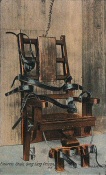
How do you cope on death row? In 1962 two psychiatrists were puzzled by the fact that inmates condemned to death in New York’s notorious Sing Sing prison were not overwhelmed by depression or anxiety. They wrote an article for the American Journal of Psychiatry attempting to explain how 13 prisoners managed the fear of their imminent demise.

It’s an uncomfortable and ill-fitting article in many ways. The two psychiatrists are firmly psychoanalytic in their approach, talking of ‘ego defense’ and ‘projective tests’, which seems odd to the modern forensic eye.

Moreover, the liberal use of the contemptuous language of sixties psychiatry pervades the article. The inmates are described variously as “inadequate”, “obsessed with his own power”, “mentally dull”, “self-pitying”, as if these were facts of the world, rather than the disdainful opinions of two comfortably employed prison psychiatrists.

Disturbingly, several of the condemned prisoners are clearly psychotic, and their madness is invariably explained away as a ‘defense mechanism’, little more than a tool for managing their anxieties.

But despite the filtering and selective reporting, it is possible to catch a glimpse of how the inmates managed their lives as the condemned.

This man stands out in the series as being the one who most successfully employed intellectualization as a means of defending against anxiety and depression. He elaborated a philosophy of life and values in which his own criminal career became not only justifiable, but even respectable. He rationalized his crimes by emphasizing the hypocrisy and perfidy of society on the one hand and by comparing himself with policemen and soldiers and others who live honorably “by the gun” on the other. This system was so effective for him that even when execution appeared imminent he maintained his hero’s martyr role and disdained to request executive clemency.

Of course, we will all die, and in recent years studies on how we live with this knowledge, so called ‘mortality salience’ or ‘terror management theory’ (TMT) research, has become a fertile field of investigation.

Research suggests that when reminded of our own death, we attempt to make ourselves feel better by aligning ourselves more closely with our social groups, cultural values and intimate partners.

But to my knowledge, only one other study has investigated how death row inmates deal with their forthcoming death.

In 2008, two Dutch psychologists, Andreas Schuck and Janelle Ward, analysed the final statements of those executed by the state of Texas to examine how they portrayed themselves and made sense of their situation.

In line with ‘terror management theory’ the majority of the last statements attempted to align the subject with our society’s notion of a ‘good’ person, often in a common pattern or sequence:

subject [reference to the self]; addresses relevant relationships (from closest to furthest); expresses internal feelings (love, hate); defines situation (responsibility, acceptance versus innocence, political statement, denial); deals with situation (self-comfort, religion, wish/hope, forgiveness, self-blame vs. accusation, denial); closure.

It seems that from the prisoner to the public, death makes us conform, and even those who may have been the most callous of killers want to be a good person when they die.

Link to 1962 death row article.
Link to PubMed entry for same.
Link to study on Texas executions last words.

Old skool lie detectors

OObject has a fantastic online gallery of vintage analog ‘lie detectors’ – exactly the type of kit you used to see in old detective films where the police questions would lead to frantic activity on the polygraph as a bead of sweat would run down the perp’s face.

It has everything from a tiny 1920s original MacKenzie-Lewis polygraph to the lie detector in a suitcase Pentograph from the 1980s

Despite polygraph-based lie detectors being rubbish at detecting lies, they’re still admissible as evidence in some US states and widely used by the security services.

Link to gallery of vintage lie detectors (via BB Gadgets).

The mysterious death of “Mad King” Ludwig

This is an interesting snippet about the mysterious 1886 death of “Mad King” Ludwig II of Bavaria and his psychiatrist found in the final part of a Lancet article on the equally mysterious Ganser syndrome.

Born in Dresden in 1853, Sigbert Josef Maria Ganser emerged from the colourful Munich circle of neurologists and psychiatrists that included Jung, Bleuler, and Alzheimer. He trained as a psychiatrist in Wurzburg, then completed his thesis in Munich under Johan Von Gudden, editor of the Archiv für Psychiatrie und Nervenkrankheiten.

Von Gudden was also the supervisor of Emil Kraepelin, and physician to the “Mad King” Ludwig II of Bavaria, last of the German feudal princes [picture on right]. Both Von Gudden and the king were to die in mysterious circumstances three days after Von Gudden certified Ludwig insane.

Their drowned bodies were found in Lake Starnberg, and it is believed that King Ludwig took his own life, as well as that of his physician who wrestled in vain to prevent him from leaping into the lake.

According to the Wikipedia page for “Mad King” Ludwig, the death by drowning is only one version of the story and (unsurprisingly) there are various conspiracy theories about what killed the monarch.

Link to Lancet article on Ganser’s Syndrome.
Link to PubMed entry for same.

Neural integration of transplanted hand

Neurophilosophy has an excellent article on a man whose brain’s sensation areas have reorganised to integrate a hand transplanted from a corpse, 35 years after the man’s original hand was destroyed in an accident.

The somatosensory cortex is literally a ‘map’ of the body. Each part on this strip of brain corresponds to an area of the body and is involved in perceiving bodily sensation.

We know that the somatosensory map is quite malleable, and can change when limbs are amputated and so no longer feed information into the system.

What happens when new limbs are attached is still largely a mystery as this type of transplant is a relatively new procedure. Nevertheless, this is now beginning to be studied and, as the Neurophilosophy article recounts, it’s starting to show us how the brain responds to a changing body:

One consequence of this functional reorganization is phantom limb syndrome, which Savage experienced for a short time following removal of his hand. This is thought to occur because although the deprived somatosensory cortical region takes on another function, it somehow retains a representation of the amputated limb. As a result, the amputee will occasionally experience sensations, sometimes painful ones, which are perceived to be in the missing body part.

In Savage’s case, it was thought that these changes may be irreversible, because his brain had been deprived of inputs from the right hand for some 35 years. But a team of neuroscientists led by Scott Frey of the University of Oregon now show that this is not the case. In a functional neuroimaging study published today in Current Biology, they report that Savage’s somatosensory cortex has been restored to something like its pre-amputation state, with the transplanted hand “recapturing” the cortical area which represented his own right hand.

The research team have put the full text of the scientific report online as a pdf file if you want to get to the nitty-gritty, otherwise the Neurophilosophy article is an elegant summary of a fascinating study.

Link to Neurophilosophy on neuroscience of hand transplant.
pdf of scientific paper.
Link to PubMed entry for same.

Brain washing in post-war London

BBC Radio 4 recently broadcast an excellent documentary on psychiatrist William Sargant who began experiments in ‘brain washing’ likely at a behest of the British secret services in post-war London.

Sargant was rumoured to have links to the notorious and secret CIA MKULTRA project that attempted to develop ‘brain washing’ or ‘programming’ techniques that were later condemned as unethical when they came to light in the 1970s.

A pioneer in early medical treatments for mental illness, he became famous after writing his book Introduction to Physical Methods of Treatment in Psychiatry and became notorious after developing techniques to keep patients asleep for weeks on end with barbiturates and electro-convulsive therapy.

After publishing some early work he was apparently contacted by UK spooks and contracted to do secret research on ‘brain washing’ style research.

He later wrote a the widely read Battle for the Mind which discussed the psychology and neuroscience of brain washing.

Interestingly, Lord David Owen, the British ex-Foreign secretary, leader of the SDP party and current member of the House of Lords, was Sargant’s registrar when he worked as a doctor at St Thomas’ Hospital in London.

Unfortunately, the BBC have recently butchered their Radio 4 website and ruined their archive by putting everything on iPlayer, so you can only listen to the programme for another 5 days and only if you’re based on the UK.

However, the programme seems to have found it’s way to Google Video, so you can listen to a streamed version there.

Link to BBC iPlayer version.
Link to alternative streamed version.

Misfortunes, Troubles, Disappointments

I’m just reading Lisa Appignanesi’s so-far excellent book Mad, Bad and Sad: A History of Women and Mind Doctors from 1800 to the Present where she reproduces an 1810 table of causes of insanity from London’s Bethlem Hospital on p54.

It was compiled by the physician William Black and lists various afflictions that have apparently caused mental illness followed by a count of the number of affected patients.

Misfortunes, Troubles, Disappointments

Grief (206)
Religion and Methodism (90)
Love (74)
Jealousy (9)
Pride (8)
Study (15)
Fright (31)
Drink and Intoxication (58)
Fevers (110)
Childbed [i.e. birth or nursing babies] (79)
Obstruction (10)
Family and Heredity (115)
Contusions and Fractures of the Skull (12)
Venereal (14)
Small Pox (7)
Ulcers and Scabs dried up (5)

Much madness is divinest sense

I’ve just found this fantastic poem by 19th century American poet Emily Dickinson, where she discusses the link between conformity and madness.

Madness is defined partly in terms of what we consider normal and one of the great critiques of psychiatry is that it is used a method of control over those who do not conform to acting with the acceptable range of behaviour.

To what extent this is necessary or ethical for people who may not have good insight into their extreme states of mind has been one of the key debates in mental health for hundreds of years.

Dickinson describes the 19th method of control (“handled with a chain”) although I can’t say I ever seen an angry person declared sane, as we still have this implicit idea that being able to control your emotions when necessary or in your interest is a sign of sanity.

Dickinson’s poem:

Much madness is divinest sense
To a discerning eye;
Much sense the starkest madness.
’T is the majority
In this, as all, prevails.
Assent, and you are sane;
Demur, you ’re straightway dangerous,
And handled with a chain.

Dickinson is probably best known among cognitive scientists for her poem on the brain (‘Wider than the sky’), which is perhaps one of the most beautiful literary pieces on our second favourite organ, and widely quoted by researchers.

Link to Bartleby entry for ‘Much madness is divinest sense’.

Tonic to aphrodisiac to energy drink

Image from Wikipedia. Click for sourceThe journal Evidence-based Complementary and Alternative Medicine has an interesting open-access article about guarana, a stimulating Amazonian berry that was used by the local peoples but is now a global ingredient in energy drinks and ‘aphrodisiacs’.

It is often advertised as an ingredient in energy drinks to make them sound more ‘exotic’ or ‘natural’, but the kick is largely from caffeine, and it contains about four times as much as the coffee bean.

Indeed, the article notes that guarana seeds contain more caffeine than any other plant in the world.

Guaran√° (Paullinia cupana H.B.K., Sapindaceae) is a rainforest vine that was domesticated in the Amazon for its caffeine-rich fruits. Guaran√° has long been used as a tonic and to treat various disorders in Brazil and abroad and became a national soda in Brazil about a century ago. In the last two decades or so, guaran√° has emerged as a key ingredient in various ‘sports’ and energy drinks as well as concoctions that allegedly boost one’s libido.

For some time, guaran√°’s high caffeine content was thought to be a detriment because of health concerns about excessive intake of caffeine-rich drinks. But it is precisely this quality, and the fact that it has a mysterious name and comes from an exotic land, that has propelled guaran√° into a global beverage.

The article is fairly brief but is a great guide to this curious plant that is becoming increasingly used as a pick-me-up ingredient.

Link to full-text of article.
Link to PubMed entry for same.

When I get that feeling, I have sexual sneezing

Photo by Flickr user Mussels. Click for sourceA few months ago, a surgeon and a psychiatrist wrote an article for the Journal of the Royal Society of Medicine on cases of sneezing triggered by sexual thoughts and orgasm. The subsequent media coverage meant that the authors were contacted by members of the public who experienced similarly unusual sneezing triggers.

The researchers have written a fascinating follow-up letter to the same journal of summarise the reaction they got from their article, and the new cases they’ve discovered.

We surmised that sneezing induced by sexual ideation or orgasm may be under-reported. Subsequent media coverage has lead to many more members of the public stating that they also have this condition. Reports have been on the JRSM website, on internet-based media fora or by unsolicited contact with the lead author. In total the number of people we found reporting sneezing induced by sexual ideation through these disparate methods is 146 (which includes seven doctors), with a further seven reporting sneezing induced by orgasm.

These triggers of sneezing appear to be mutually exclusive; people report either sneezing upon sexual ideation or sneezing upon orgasm. Of those reporting sneezing upon sexual ideation 112 (77%) were men, as were all seven of those reporting sneezing with orgasm, but the gender disproportion may represent sexual bias in the reporting rather than the prevalence of these conditions. Nevertheless, these figures do show that these conditions are not infrequent, and imply that perhaps thousands of people in the UK are affected; many stated that they had never discussed this phenomenon and were relieved to hear that they were not alone.

We also wish to report that two people contacted us to state that several members of their family sneeze on a full stomach; this now doubles the number of families in the medical literature reported to have this as a trigger of sneezing. Interestingly, two of the people who reported sneezing on sexual ideation also admitted to a family history. One lady reported that her brother had the same phenomenon. A man reported that both his brothers and his father also had this. This implies, as we suggested in our original article, that all the unusual triggers of sneezing – light, full stomach, sexual ideation or orgasm – may be inherited in an autosomal dominant manner.

That last sentence is interesting, because a confirmed autosomal dominant pattern of inheritance means that it is likely to be due to changes in a single gene.

This doesn’t mean a single gene has evolved to trigger or prevent sneezing when people have sexual thoughts – this would likely be a ‘side-effect’ some other useful function.

Interestingly, sneezing in response to sunlight is known to be inherited in an autosomal dominant pattern.

Consequently, it has been given the name Autosomal dominant Compelling Helio-Ophthalmic Outburst syndrome, or the ACHOO syndrome.

Link to PubMed entry for original article.
Link to follow-up letter.

Seven tactile illusions

New Scientist has got a nice feature online where they explain seven touch illusions you can try yourself, with the explanations for how they’re tricking your brain.

My favourite is probably the most simple, the ‘Aristotle illusion’:

One of the oldest tactile illusions is the Aristotle illusion. It is easy to perform. Cross your fingers, then touch a small spherical object such as a dried pea, and it feels like you are touching two peas. This also works if you touch your nose.

This is an example of what is called “perceptual disjunction”. It arises because your brain has failed to take into account that you have crossed your fingers. Because the pea (or nose) touches the outside of both fingers at the same time – something that rarely happens – your brain interprets it as two separate objects.

It’s a fantastic little collection and it follows on from NewSci’s recent collection of five auditory you can check out online.

Link to NewSci seven tactile illusions.

A brief history of aspirin

Wired has a brief article on the history of aspirin, which contains the surprising fact that the same pharmacist who first synthesised the popular headache pill also first synthesised heroin.

1899: Felix Hoffmann, a young pharmacist working for the German pharmaceutical company Bayer, patents a new pain reliever. The trademark name is aspirin.

Hoffmann, who was said to be seeking an effective pain reliever for his father’s rheumatism, successfully synthesized acetylsalicylic acid in August 1897. It would later be marketed as aspirin ‚Äî “a” for “acetyl” and “spirin” for Spirea, the genus name of the source plant for salicylic acid, the pain-relieving agent.

That August, incidentally, was an especially fertile period for Hoffmann: The month also saw him synthesize heroin, which he accomplished accidentally while attempting to acetylate morphine to produce codeine. Obviously, that discovery didn’t pan out like aspirin.

It turns out that aspirin was a huge money-spinner for pharmaceutical company Bayer owing to persuasive marketing and powerful patent lawyers.

Link to Wired on the birth of aspirin.