The birth of a visual artist, after blindness

Psychologist Lawrence Rosenblum’s Sensory Superpowers blog covers the remarkable story of blind artist John Bramblitt who creates the most strikingly vivid images but didn‚Äôt start painting until he lost his sight.

To judge colour Bramblitt feels the small differences in the thickness and texture of the paint and the piece discusses how such fine touch distinction become more possible after sight loss owing to what is known as cross-modal plasticity:

For color, Bramblitt uses oil paint, which has proven critical to the process. While oil paint is messier, more pungent, and dries much slower than acrylics, it offers something that no other paint can: idiosyncratic viscosity. According to Bramblitt, “White feels thicker on my fingers, almost like toothpaste, and black feels slicker and thinner. To mix a gray, I’ll try to get the paint to have a feel of medium viscosity”. In fact, he has learned to recognize and mix all the colors he uses by his sense of touch. And the colors are the first thing one notices about Bramblitt’s work (www.Bramblitt.net). While the subjects of his paintings are immediately recognizable, proportioned, and smartly stylized, the colors are supremely vibrant, and nearly psychedelic in their rendering.

John Bramblitt has developed his touch skills in particularly impressive ways. But the enhancement of the touch sense is known to generally occur for blind individuals. Research has shown that regardless of training in Braille, the blind have better touch skills than the sighted, especially when it comes to touching complex spatial patterns. This cross-modal plasticity is thought to be a result of the blind’s visual cortex being reassigned to other senses. Brain imaging shows that when touching complex patterns, the visual cortex of blind, but not sighted individuals is activated in systematic ways. Moreover, inducing a transient brain lesion (using transcranial magnetic stimulation) in visual cortex will disrupt some of the tactile skills of blind, but not sighted subjects.

The author of the article researches cross-modal plasticity and followers of his blog will be aware that he often comes up with striking examples of the effect in action.

We covered another one of his posts, about blind mountain bikers who make clicks as a form of human ‘echolocation’, back in July.

If want to see more of Bramblitt’s artwork, there’s plenty more over at his website.

Link to ‘Painting by Touch’ article.
Link to John Bramblitt’s website.

A study on dream smoking

Photo by Flickr user lightbrigade. Click for sourceIf you’ve given up smoking for good, where else can you have a secret cigarette except in your dreams? A 1991 study looked at how often recently ex-smokers dreamed of smoking, and found that even after a year of abstinence the dream world was often a common refuge for an imaginary nicotine hit.

Dream of absent-minded transgression: an empirical study of a cognitive withdrawal symptom.

J Abnorm Psychol. 1991 Nov;100(4):487-91.

Hajek P, Belcher M.

Among 293 smokers abstinent for between 1 and 4 weeks, 33% reported having at least 1 dream about smoking. In most dreams, subjects caught themselves smoking and felt strong negative emotions, such as panic and guilt. Dreams about smoking were the result of tobacco withdrawal, as 97% of subjects did not have them while smoking, and their occurrence was significantly related to the duration of abstinence. They were rated as more vivid than the usual dreams and were as common as most major tobacco withdrawal symptoms. In subjects abstinent for 1 year, 63% recalled having dreams about smoking. They had on average 5 of them, and about a quarter occurred after the 6th month of abstinence. Having dreams about smoking was prospectively positively related to maintenance of abstinence. An explanation of this finding based on the association of smoking in dreams with aversive emotions is offered.

It’s an interesting finding in light of Freud’s theory that dreams are a form of wish-fulfilment. Importantly though, he suggested that psychological conflicts would be hidden from the conscious mind and would therefore appear in a symbolic form during dreaming.

The fact that ex-smokers seem to light up so blatantly in dreams suggests that this isn’t the case.

Link to PubMed entry for study.

Broken hearted

Photo by Flickr user Gabriela Camerotti. Click for sourceThe Wall Street Journal has an article on a curious medical condition called ‘broken heart syndrome’ where grief or strong emotion seems mimic a heart attack.

The piece starts with a case description of a lady who had just experience the death of her husband from a heart attack and her reaction which seemed to also be a heart attack:

When doctors performed an X-ray angiogram expecting to find and treat a blood clot that had caused Mrs. Lee’s symptoms, they were surprised: There wasn’t any evidence of a heart attack. Her coronary arteries were completely clear.

Doctors eventually determined that Mrs. Lee had suffered from broken-heart syndrome, a name given by doctors who observed that it seemed to especially affect patients who had recently lost a spouse or other family member. The mysterious malady mimics heart attacks, but appears to have little connection with coronary artery disease. Instead, it is typically triggered by acute emotion or physical trauma that releases a surge of adrenaline that overwhelms the heart. The effect is to freeze much of the left ventricle, the heart’s main pumping chamber, disrupting its ability to contract and effectively pump blood.

The condition is also known as Takotsubo cardiomyopathy and it’s probably worth saying that the idea that the condition is caused by a spike of adrenaline is still under debate although the WSJ article does a good job of looking at alternatives further down the piece.

Link to WSJ on ‘broken heart syndrome’ (via @dreamingspires)

A varied diet

A 1964 article from the Archives of Surgery discusses how to treat psychotic patients who may have ingested inedible objects.

It reports on one remarkable case where the following list of objects was found in one patient’s stomach. They also helpfully provided a photo of all the objects laid out on a table.

Nickels (173), Pennies (161), Quarters (3), Dimes (26), Military buttons (22), Insignia clasps (5), Nails (50), Staples (5), Screws (16), Metal bolt (1), Metal nuts (4), Overall buckles (19), Metal cap top with keys (8), Lock key (1), Crucifix (2), Bottle caps (2), Knife handle (1), Fork handle (1), Spoon handle (1), Complete fork (bent double) (1), Dessert spoon (1), Rifle shell (unexploded) (1), Pieces of lead (14), Brass ball (1), Pieces of brass (3), Pins and needles (27), Watch parts (22), Broken earring (1), Rings with chain (2), Pieces of wire (7), Nondescript pieces of metal (16), Empty cigarette package (with tinfoil) (1), Official War Department letter (wrapped in cellophane) (1), Piece of glass (1), Streetcar tokens (2), Several small packages of cancelled postage stamps wrapped in cellophane.

Rifle shell? Blimey.

The persistent eating of inedible objects is known as pica although rarely does it occur in such as spectacular fashion.

Link to PubMed entry for 1964 study.

One Hundred Years of Memory Loss

Image from Wikipedia. Click for sourceNeurology journal Brain has a fantastic article on the close parallels between the effects of semantic dementia, a degenerative brain disease that causes the loss of memory for the meaning of words and objects, and the novel A Hundred years of Solitude where a magical disease affects villagers’ memory for ‘the name and notion of things’.

The novel is by the Nobel-prize winning Colombian writer Gabriel García Márquez and is famous for founding the magical realism style of fiction where fantastical things seem to happen in an otherwise ordinary world.

What is interesting about One Hundred Years of Solitude is that while the memory loss closely resembles the effects of semantic dementia, it was written before the condition was recognised by neurology.

Unfortunately, the article isn’t available online but this an excerpt from the article which captures the main themes:

In One Hundred Years of Solitude, García Márquez created a literary depiction of collective semantic dementia before the syndrome was recognized in neurology. The memory plague section of the novel also provides an inspiring and human account of one town’s fight against “the quicksand of forgetfulness”.

Why does García Márquez envision a world in which people lose their ability to communicate the names of everyday things? He gives some insight into his use of magical realism in the opening lines of the novel, in which he describes the village of Macondo in its earliest days: “the world was so recent that many things lacked names, and in order to indicate them it was necessary to point”. With this description, García Márquez implies that the ability to assign a name to an everyday object is a defining human achievement that has developed over time. In this light, the insomnia plague forces Macondo villagers into a primitive state by robbing them of their ability to remember “the name and notion of things”.

Remarkably, García Márquez’s probing investigation of the power of words and everyday names leads him to a striking literary enactment of the clinical syndrome of SD [semantic dementia] and the problems faced by SD patients. His fictional characters, just like the SD patients discussed here, are acutely aware of the “infinite possibilities of a loss of memory”. Both patients and characters attempt to preserve semantic meaning in more permanent forms that are free from the devastating effects of a neurodegenerative process and a fantastical plague. As such, García Márquez achieves a masterful portrayal of SD not just in his description of the plague’s ravaging effects on semantic knowledge, but even more vividly in his account of the affected people’s ability to maintain hope through various coping strategies – to preserve their fragile self-identity in the pages of word lists and pocketbook diaries.

 
Link to PubMed entry for article.

The internet, depression and drinking a glass of water

Photo by Flickr user Hoggheff aka Hank Ashby aka Mr. Freshtags. Click for sourceA new study has made headlines around the world that claim that internet use is linked to depression despite better evidence from previous studies that there is no substantial link.

The study itself is a fairly straightforward online survey with the key finding that out of 1,319 people who completed the questionnaires, 18 were identified as ‘addicted’ by Kimberly Young’s Internet Addiction Questionnaire and these people were more likely to score highly on the BDI – a standard questionnaire to measure depression.

The study itself was well conducted although it is not a surprising finding because Young’s Internet Addiction Questionnaire (which you can read online here) asks lots of questions about emotional distress, so it’s hardly surprising that people who say they’re distressed on one questionnaire will say they’re distressed on the other.

I have criticised the concept of internet addiction on the basis that the whole concept doesn’t make sense, but research has also shown that these ‘diagnostic’ questionnaires are not particularly reliable, meaning they not a good guide even to what they claim they’re doing.

But perhaps the most important point, is that this study is just one in a long line of studies that have looked at whether internet use is linked to changes in mood.

Recently, a type of study called a meta-analysis was published that looked at all of these previous studies to see what the overall effect was – in essence, a mathematical aggregation of all the reported findings to get at the big picture.

This meta-analysis found that there was a statistically reliable link between internet use and depression, but one so small as to be insignificant. In fact, it found that internet was responsible for between 0.02% and 0.03% of total changes in mood (stats geeks: the variance was not reported directly but I calculated it from the r by the coefficient of determination).

In other words, internet use explains so little of a person’s depression that it’s irrelevant. It’s like knowing that hypothermia is a serious medical condition and that drinking a glass of water reliably lowers body temperature, but by such a small amount as to be medically unimportant.

Interestingly, I am quoted in some of the news stories about the study. Actually, I was contacted by a BBC journalist and some other stories have seemingly just nicked the quotes (often wrongly describing me as a psychiatrist).

What’s curious is that I sent the BBC journalist a link to the meta-analysis, even explained what it found and what a meta-analysis is, and included comments about why the study doesn’t change the general conclusion.

Instead of focusing on the existing evidence, I am quoted as being a naysayer. I have not been misquoted but the most important scientific point is omitted at the expense of presenting my words. This seems to be a common pattern where news stories often privilege opinion over data, when science privileges data over opinion.

In fact, the motto of the Royal Society, the world’s oldest scientific society, translates as “on the words on no-one”, but news stories often turn the hierarchy of evidence on its head, giving a skewed impression of the most fundamental way in which science works.

In this case, to suggest that science has established that internet use is strongly linked to depression when we know that it isn’t.

Link to PubMed entry for latest study.
Link to PubMed entry for meta-analysis.

Injecting heroin with a doctor

Slate has two articles on an innovative but controversial service in Vancouver, Canada, that provides injecting drug users with a place to safely inject drugs with clean equipment and medical staff on hand.

The project, ‘Insite’, is based on a ‘harm reduction‘ approach which is driven by the idea that users should be encouraged to take drugs in the safest way possible.

This is partly an admission that addiction treatment is not very successful on its own, but partly a public health measure in that injecting drug users have much higher rates of diseases such as HIV and hepatitis and are more likely to pass them on to other people.

It is also the case that one of the biggest dangers from injecting drugs is the actual practice of injecting, as unsanitary conditions, ad-hoc ‘cooking up’ and unpredictable street dope as become much more risky when the final product is injected into the bloodstream.

These services can be controversial in some places as they can be seen to be condoning drug use, although some countries are now going further and actually prescribing heroin to addicts.

One of the biggest impacts on society is not the fact that a tiny minority of people are damaging themselves with smack, but that they tend to commit crimes to feed their habit and support a violent criminal network of dealers.

Methadone is a heroin substitute that has been prescribed for years and we know that it can stabilise the lives of users and increase their chance of kicking the habit.

But it is often not what users want. It stops the withdrawals, as it’s another form of opioid drug, but it doesn’t feel the same and still has the danger of overdose. One common problem is known euphemistically in the medical literature ‘methadone diversion‘ where users sell their methadone to buy street drugs.

Several countries have trialled the prescription of heroin itself, with, it turns out, a great deal of success – including better health, a reduction in criminal activity and a higher chance of actually kicking the habit.

This may seem counter-intuitive, but one of the advantages of these projects is that the user is constantly in contact with health professionals who can provide addiction treatment.

The political and local opposition to harm reduction services is usually immense, however. Politicians want to be seen to be ‘tough on drugs’ and no-one, and I mean no-one, wants one of these clinics near where they live.

The Slate articles looks into the day-to-day running and talks to some of the clients of the Vancouver programme, and provides an insight into the challenges such services face. There’s also a gallery of photos that captures the project in action.

Link to Slate article ‘Welcome to Insite’.
Link to Slate article ‘Upstairs, Downstairs’.
Link to photos of the Insite project.

The rise and fall of antidepressants

Newsweek has an excellent article that charts the rise and fall of antidepressants from their status as a wonder drug that made people ‘better than well’ to the recent evidence that suggests for many people, they’re not much better than placebo.

The piece particularly follows the work of psychologist Irving Kirsch who was the first to conduct a meta-analysis of the effects of anti-depressants back in 1998.

Titled “Listening to Prozac but hearing placebo” it suggested that the drugs were hardly more effective than placebo and, for many, marked Kirsch out as a biased and dangerous ‘anti-psychiatrist’.

However, later studies in a similar vein by both Kirsch and others have supported his original findings and many countries have now changed their treatment recommendations as a result.

The Newsweek article tracks this story but also picks up on many important subtitles in the story, notably that the research doesn’t suggest that antidepressants are useless – quite the opposite – just that their effect is only in part due to their direct chemical effect; and that many patients in trials work out that they’re not taking placebo because of the side-effects and this realisation can trigger a stronger placebo effect.

It also integrates evidence from the recent STAR*D study, one of the most complete on the best methods to treat depression.

If you want a good overview of the debate on the effectiveness of these iconic drugs, this is a good place to start.

Additionally, if you’re interested in a good analysis of the most recent study in this area, just published in the Journal of the American Medical Association, the Neuroskeptic blog has a great write-up and analysis of what this means for the concept of depression itself.

Link to Newsweek piece on antidepressants (via @DrDavidBallard).
Link to write-up of JAMA study at Neuroskeptic.

Can you actually be frightened to death?

Photo by Flickr user Kman999. Click for sourceScience isn’t sure whether fear can kill but several courts have been convinced and have convicted people for murder on the basis that they caused death through fright. An article just published in the American Journal of Cardiology summarises the eight murder trials.

The cases are not, as I first suspected, where someone had deliberately tried to kill someone else using fright as a ‘weapon’ (like in the infamous scene in Belgian serial killer mockumentary Man Bites Dog – clip here – warning: not pleasant).

Instead, they typically describe where someone has died of a heart attack in the midst of an armed robbery or assault, despite not being mortally wounded.

In a similar case, State v. Edwards,10 the defendant and his accomplices entered a bar in Tucson, Arizona and committed a robbery at gunpoint. Shortly after the robbers had fled, the proprietor experienced a heart attack and died. The defendant argued that the victim’s death was accidental and unintended and could not constitute murder. Moreover, the defendant maintained that the evidence was insufficient to prove that the robbery actually caused the victim’s death.

The court disagreed on both counts, finding first that accidental, unintended consequences could form the basis of a murder conviction. Second, the court pointed to the testimony of a pathologist that the death was caused by anxiety resulting from the robbery at gunpoint. The court held that this provided adequate evidence to support causation.

However, this is not the only area where supposedly being ‘frightened to death’ has caught the interest of psychologists. There is a small psychological literature on ‘psychogenic death’ that attempts to explore reports of death after curses, spells or violation of cultural taboos.

This is from an excellent brief article from 2003, published in the journal Mental Health, Religion & Culture:

Landy (1977, p. 327) describes the phenomenon as follows: ‘a process is set in motion, usually by a supposed religious or social transgression that results in the transgressor being marked out for death by a sorcerer acting on behalf of society through a ritual of accusation and condemnation; then death occurs within a brief span, usually 24 to 48 hours’. Ellenberger (1965) distinguishes acute from slow psychogenic death. In some cases, the death can be rapid, in other cases the process occurs over several weeks where the patient sickens and dies. There has been some doubt expressed as to whether voodoo death is part of ‘colonial folklore’ only based on anecdotal reports (Williams, 1928).

Lewis (1977, p. 11) asks, ‘Is it really the case that healthy people have died in a day or three days because they know they were victims of sorcery? Who has seen this happen with his own eyes? Is there no explanation for it but sorcery?’ Yap (1977) calls for concrete findings from anthropologists and medical field workers that can be appraised critically. Questions have arisen as to whether or not these victims had pre-existent pathological conditions predisposing them to death. There is however some direct evidence for its occurrence.

The evidence is not people just dropping dead, but from several documented cases where perfectly healthy people rapidly give up eating and drinking after being ‘cursed’ and dehydration leads to death.

Link to PubMed entry for ‘Homicide by fright’ article.
Link to DOI entry and summary for ‘psychogenic death’ article.

The soporific boogaloo

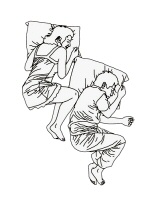
The Guardian has a short piece and gallery on what couple’s sleeping positions say about their relationship. The article is based on a humorous book called The Secret Language Of Sleep and it’s not quite clear that the writer has picked up on the fact its not meant to be taken too seriously.

The idea that sleep position is linked to personality is surprisingly popular but largely untested. Only poorly controlled study has ever tried to investigate the issue. It chose only 6 out of 14 sleep position recorded from 51 females and concluded that “Sleep positions, particularly the full fetal position, appear to be related to CPI [California Psychological Inventory] variables of Sociability, Sense of Well Being, Achievement by Conformance, Femininity, and Social Maturity”.

The general idea, however, has quite an interesting history. It was originally suggested in passing by the early psychoanalysts and fits well into Freud’s theory of dreaming.

He suggested that when we sleep we are left alone with our unconscious which may contain lots of unpleasant or unwanted desires we don’t want to think about. If we did, we might become so emotionally disturbed as to wake up, therefore, according to Freud, dreams serve to hide our unconscious desires from us by presenting them to us in a more acceptable symbolic form.

From this perspective, dreams serve to keep us asleep and Freud’s big idea was that we can analyse the dream’s ‘manifest’ or obvious content to give us an insight into the ‘latent’ or unconscious meaning. This is why Freud famously wrote that dreams are a “royal road to the unconscious”.

According to Freudian theory, our personalities are largely a reflection of how we manage and ‘defend’ against out our unconscious desires. As our dreaming life occasionally breaks through into movement or speech when we sleep, it’s not a big leap to link sleep position with personality.

This link was made explicitly in a 1979 book called Sleep Positions: The Night Language of the Body by the psychoanalytically inclined psychiatrist Samuel Dunkell. In the book, Dunkell readily admits there is no research to back up his ideas but links personality with sleep position on the basis of individual cases and anecdotes from his own practice, as psychoanalysts have a tendency to do.

Despite being based almost entirely on one man’s opinion, the book has been remarkably influential in pop culture and there has been a steady trickle of media interest ever since that has repeated the main ideas.

In fact, the Huffington Post, which has become an unintentional champion of dodgy science, ran a piece only last week that claimed to explain ‘What Your Sleep Position Says About You’ based almost entirely on Dunkell’s book.

There was a brief media splash in 2003 when sleep psychologist Chris Idzikowski claimed almost exactly the same based on a ‘new study’ but it never appeared and was presumably a PR piece for the private sleep clinic he worked for.

So we don’t really know if sleep position is linked to personality, and certain can’t ‘read’ anything about you from your night-time body position.

But the theory is so popular that even a satirical book can apparently be misinterpreted as supporting the idea.

Link to Guardian piece ‘The politics of sharing a bed’.

The dream life of children

Photo by Flickr user Grace. Click for sourceWhile we may have an elaborate dream life as adults, it seems we develop the ability to have rich and vivid dreams as we grow – children start off having relatively simple dreams that become more complex throughout childhood.

Below is an excerpt from a scientific review article on ‘dreaming and the brain’, shortly to be published in Trends in Cognitive Sciences, that addresses how our dream life changes and develops during our early years.

One of the criticisms of these findings might be that dreams seem less complex in younger children because their language isn’t rich enough to describe them fully. However, there is good evidence against this idea – the complexity of dreams is not strongly related to verbal ability, although it is to the vividness of the child’s mental imagery.

When do children start dreaming, and what kind of dreams do they have? Given that children often show signs of emotion in sleep, many assume that they dream a great deal. However, a series of studies by David Foulkes showed that children under the age of 7 reported dreaming only 20% of the time when awakened from REM sleep, compared with 80–90% in adults.

Preschoolers’ dreams are often static and plain, such as seeing an animal or thinking about eating. There are no characters that move, no social interactions, little feeling, and they do not include the dreamer as an active character. There are also no autobiographic, episodic memories, perhaps because children have trouble with conscious episodic recollection in general, as suggested by the phenomenon of infantile amnesia.

Preschoolers do not report fear in dreams, and there are few aggressions, misfortunes and negative emotions. Children who have night terrors, in which they awaken early during the night from SWS [slow-wave sleep] and display intense fear and agitation, are probably terrorized by disorientation owing to incomplete awakening rather than by a dream. Thus, although children of age 2–5 years can see and speak of everyday people, objects and events, they apparently cannot dream of them.

Between the ages of 5‚Äì7 years, dream reports become longer, although they are still infrequent. Dreams might contain sequences of events in which characters move about and interact, but narratives are not well developed. At around 7 years of age, dream reports become longer and more frequent, contain thoughts and feelings, the child’s self becomes an actual participant in the dream, and dreams begin to acquire a narrative structure and to reflect autobiographic, episodic memories.

It could be argued that perhaps all children dream, but some do not yet realize that they are dreaming, do not remember their dreams, or cannot report them because of poor verbal skills. Contrary to these intuitive suggestions, dream recall was found to correlate best with abilities of mental imagery rather than with language proficiency… Put simply, it is children with the most developed mental imagery and visuo-spatial skills (rather than verbal or memory capabilities) that report the most dreams, suggesting a real difference in dream experience.

I’ve removed the numeric references for ease of reading, but you can find the full research sources in the original article.

Link to PubMed entry for article.
Link to DOI entry for same.

Hard as nails

Tom alerted me to this fantastic brief case published in the British Medical Journal where a builder is admitted to hospital in great pain after a nail penetrated all the way through his boot. But it turned out that the pain was entirely psychological, as the nail had missed his foot by sliding between his toes.

A builder aged 29 came to the accident and emergency department having jumped down on to a 15 cm nail. As the smallest movement of the nail was painful he was sedated with fentanyl and midazolam. The nail was then pulled out from below. When his boot was removed a miraculous cure appeared to have taken place. Despite entering proximal to the steel toecap the nail had penetrated between the toes: the foot was entirely uninjured.

As Tom mentioned “One of the things I love about it is that the builder had no incentive to ‘fake’. He knew he should have acted tough so we know that the pain he felt wasn’t over-acting. It was imaginary pain, but it was real imaginary pain!”

This isn’t really the nocebo effect, where ‘side-effects’ appear after having taken nothing but a placebo, but more similar to what doctors might describe in its persistent form as somatisation disorder where physical symptoms appear that aren’t explained by tissue damage.

However, both are similar in that real pain arises from beliefs, expectations and perceptions. We now know that all pain has a significant mental component and, consequently, psychological therapy is an effective treatment for chronic pain.

It’s no coincidence that Tom picked up this snippet in a talk by psychologist Stuart Derbyshire who has done some fantastic studies on the neural basis of psychologically controlled and induced pain by using hypnosis in fMRI scanners.

Link to brief piece in the BMJ.

Beyond crossed senses in synaesthesia

Cognitive Daily covers a super-elegant study that helps us understand whether synaesthesia is really just a case of ‘crossed senses’ or whether the perceptual blending effect requires the person to have processed some of the meaning of the triggering experience.

The traditional explanation of most types of synaesthesia is that the brain’s sensory areas are overly connected, so activation of one sense triggers activity in another area which causes the experience. However, there has been some recent evidence that synaesthesia doesn’t work purely at this basic sensory level.

For example, a recent study by neuropsychologist Jamie Ward and colleagues reported that letter-colour synaesthetes needed to be concentrating on the letters to trigger colours – seeing them ‘out of the corner of the eye’ didn’t work – suggesting there must be some involvement of focus and concentration and not just a reliance on incoming sensory information.

To test the idea further, it would be ideal to be able to separate out experiences where we process just sensory information and experiences where we also understand meaning but as we tend to deal with both at once, this is not easy to do.

But this new study managed to do exactly this in people with colour-speech synaesthesia, where affected people experience colours when they hear specific words, using a perceptual illusion called the McGurk effect.

It’s an intriguing effect that you can see in action on the Cognitive Daily page, but essentially, it shows that seeing someone mouth a word affects what we hear, so if we are played the syllable ‘gah’, but see someone mouthing ‘bah’, the brain makes a compromise and we experience hearing the syllable ‘dah’.

So the effect is a perfect tool to separate out sensory information and meaning, because the researchers can play exactly the same sound but change what word the participants hear simply by showing clips of people mouthing different words.

If colour-speech synaesthesia works only through crossed-senses then the McGurk effect should make no difference to the colours because the exact same sound is played each time, but if this form of synaesthesia is triggered by meaning, the colours should differ because the McGurk effect changes which words are perceived and understood, despite the identical sound.

This is exactly what the researchers found, providing additional evidence that synaesthesia is not just a sensory confusion, it is based in how the brain understands meaning.

It’s an incredibly elegant study and the Cognitive Daily piece covers it equally as elegantly.

Link to CogDaily on ‘Synesthesia and the McGurk effect’.
Link to PubMed entry for study.
pdf of study full text.

The museum of narcoculture

The Washington Post has an absolutely astounding gallery that looks inside Mexico’s ‘Museum of Drugs’ that is only open to government and army officials and chronicles the ongoing narcowar.

It’s not only a museum of drugs samples and smuggling methods, it also captures some of the culture of the narcotraffickers – including captured diamond encrusted guns and items from branded clothing created by cartels for their members.

Around the corner, the exhibits show how drugs are smuggled, and here human ingenuity is on full display. There is dope hidden inside picture frames, logs, gas tanks, clay pots, tamales, concrete blocks, truck tires, soda cans, car bumpers, shoes, stuffed armadillos and a statue of the Virgin of Guadalupe.

There is a kind of James Bond or Dr. Evil quality to some exhibits. An attache case confiscated from an outlaw surveillance team holds computer boards and other gadgetry to monitor cellphone calls. The cartels now employ their own fleets of semi-submersible submarines. On display is a large sea buoy with a coded beacon device the traffickers attach to huge payloads of drugs they can dump into the sea and pick up later.

Also, apparently, the narcos now have their own line of clothes. There are dark blue polo shirts sporting a kind of family crest for the Zetas, a notorious cartel founded by former special forces soldiers that controls vast swaths along the Gulf of Mexico from Brownsville, Tex., to Cancun. The shirts, which appear to be 100 percent cotton, are emblazoned with a Z and the words: “Cartel del Golfo.”

One of the most fascinating pictures is of a shrine to the unofficial saint Jes√∫s Malverde, literally worshipped by the drug trafficker subculture to bring good luck. It turns out there are a great deal of Malverde videos on YouTube, some of which are tribute videos, others are clips of films or songs about him.

The museum is clearly curated with a great deal of care and consideration and has an slightly uncanny kitsch style that belies its morbid undertones.

Link to WashPost gallery of Mexico’s drug museum.
Link to WashPost article on a visit to the museum (via BoingBoing).

Animal mind reading

Image from Wikipedia. Click for sourceRadioLab has a fantastic programme on what animals can understand about the minds of humans, their own species, and other creatures.

When we gaze into the eyes of our beloved pets, can we ever really know what they’re thinking? Is it naive to assume they might be experiencing something close to the emotions we feel? Or, on the contrary, is it ridiculous to assume that they AREN’T feeling anything back? In this hour of Radiolab, we explore what science can say about what goes on in the minds of animals.

Wonderfully put together, fantasti… oh you know the rest.

Link to RadioLab ‘Animal Minds’ episode.

The hazards of injecting toad venom

Image from Wikipedia. Click for sourceThe Journal of Forensic Sciences has an interesting, if not tragic, case of a death after the injection of toad extract. The injector apparently though he was injecting MDMA (‘escstasy’) but the substance he was sold turned out to contain lethal levels of bufotenine, a toad venom, which is occasionally used as a hallucinogenic drug.

From the case study:

A 24-year-old male was observed to collapse and die soon after an intravenous injection of 35‚Äì40 ml of what was thought to be ‚Äòecstasy‚Äô (methylenedioxy-methamphetamine or MDMA). A friend had injected a smaller volume (20 ml) and had vomited but survived. The decedent was a known intravenous amphetamine user but was not known to abuse any other illicit drugs. The body was transferred to FSSA for autopsy along with a plastic bag containing the injected material and the empty syringe…

The basic extract was also found to contain paracetamol, promethazine and diclofenac, in addition to bufotenine…

Bufotenine (dimethylserotonin) is a tryptamine derivative alkaloid related to the neurotransmitter serotonin. It is found naturally in certain plants and in the secretions of various toads. Resibufogenin, cinobufagin and bufalin, known collectively as bufadienolides, are nitrogen-free steroidal lactones that are also found in toad venom. They may be cardiotoxic, having a similar effect to digoxin [an extract of the foxglove plant]. Toad secretions have also been dried and smoked as bufotenine has hallucinogenic effects, resulting in classification as a prohibited substance in Australia.

Link to PubMed entry for case study.