More on psychedelic therapy

Christian just reminded me that New Scientist had an article last year on psychedelic therapy research which is freely available online.

The article describes a number of recent and ongoing studies into the safety and efficacy of psychedelics for a range of disorders. This is despite difficulties caused by legal restrictions and political resistance to substances typically associated with the ‘counter-culture’.

Why are women’s brains smaller than men’s?

sMRI_small.jpgThe Times has a short piece on the question of why female brains are generally smaller than male brains. The author speculates that it may be because women are generally more pleasant (and smaller in body size).

Surprisingly, the conclusions are largely drawn from evolutionary studies of foxes. Probably not one to take particularly seriously, although an interesting hypothesis nonetheless.

Link to article in The Times (via anomalist).

the man who took 40,000 ecstasy pills in nine years

mdma2.jpg
The Guardian carries a story about a man who took 40,000 Ecstasy pills over nine years. The man sounds a wreck – paranoia, hallucinations, depression and extreme short-term memory loss, despite not having taken Ecstasy for seven years.

The story provides a good illustration of some of the methodological problems with proving that MDMA use is dangerous

  • This was an extreme case – does normal recreational use of ecstasy have the same effects, but less, or is the amount consumed by most people well within their ability to safely process the drug? Many animal studies which show harmful effects of MDMA use similarly extreme procedures – giving monkeys the equivalent of 50 pills over three days, for example. Although this demonstrates that MDMA can be harmful, the implications for ‘normal’ drug use among humans are not clear.
  • Other research, published today, but not mentioned in the Guardian article until towards the end, suggest that the side-effects of ecstasy use are temporary. The research mentioned failed to find a significant difference between users and non-users in either amount of depression or in neuroanatomical differences revealed by brain scans. But this can’t prove that there’s isn’t an effect (because absence of evidence isn’t evidence of absence).
  • The man was also a heavy cannabis user (and probably other things too), although this also isn’t mentioned until the end of the article. It is hard to be sure which drug(s) caused his problems.
  • Finally, what kind of man would take 40,000 ecstasy pills?! His psychological and, potentially neurological, make-up was probably unusual before he went anywhere near the E

  • Link: ‘The strange case of the man who took 40,000 ecstasy pills in nine years’ (The Guardian)
    Link: Erowid.org pages on MDMA

    Anarchic hand

    PsychologistOct2005Cover.gifAn article from The Psychologist has just been made available on the ‘anarchic hand syndrome’ – the brain injury-related condition where the hand performs actions against a person’s will.

    One evening we took our patient, Mrs GP, to dinner with her family. We were discussing the implication of her medical condition for her and her relatives, when, out of the blue and much to her dismay, her left hand took some leftover fish-bones and put them into her mouth (Della Sala et al., 1994). A little later, while she was begging it not to embarrass her any more, her mischievous hand grabbed the ice-cream that her brother was licking. Her right hand immediately intervened to put things in place and as a result of the fighting the dessert dropped on the floor. She apologised profusely for this behaviour that she attributed to her hand’s disobedience. Indeed she claimed that her hand had a mind of its own and often did whatever ‘pleased it’. This condition is known as anarchic hand: people experience a conflict between their declared will and the action of one of their hands.

    The article is by neurologist Sergio Della Sala who has been researching anarchic hand syndrome for many years.

    It discusses the possible causes of the condition, and what these disruptions to human ‘free will’ tell us about how the brain generates the conscious control of actions.

    Link to article.

    Deep brain stimulation for depression

    dbs_diagram.jpgThere’s a piece in The Guardian discussing recent investigations into treating severe depression using deep brain stimulation – a technique that uses a permanently implanted electrode to stimulate a specific brain area.

    This technique has been used to successfully treat some of the movement symptoms in Parkinson’s disease and is now being researched to see if it can be applied more widely.

    Preliminary research by neuroscientists in Canada and the Netherlands has already suggested that the treatment could prove effective. Last year, Helen Mayberg, a neurologist at Emory University’s school of medicine in Atlanta, published the results of a decade of research which pinpointed a 2.5cm-wide part of the brain called the subgenual cingulate region (SCR) as playing a major role in dealing with affective information. The SCR is the lowest part of a deep band of tissue running along the central part of the brain. Dr Mayberg had noticed that this region was overactive in depressed people and that its activity correlated with their changing symptoms. When they were treated with antidepressant drugs, the activity went down.

    Link to article from The Guardian
    Link to Wikipedia article on DBS.
    Link to previous post on Mind Hacks on ‘Modern-day psychosurgery’.

    Cognitive control and Tourette’s tics

    body_blur.jpgI’ve just noticed that Christian has written up a great summary of recent research which suggests that people with Tourette Syndrome, a neurological condition that causes involuntary movements or vocal outbursts, have better ‘cognitive control’ than people without the syndrome.

    This is quite surprising, as at first site, you might think that people with Tourette’s have poor control because of their involuntary movements.

    In the study, the experimenters assessed cognitive control by asking participants to make quick eye movements to on-screen targets. The participants with Tourette’s could do this far more effectively than the control participants.

    The fact that people with Tourette’s can do these tasks better than others may be due to the fact that they have a lot of practice trying to control their tics. In fact, it is a myth that they have no control, as some people can ‘hold in’ tics and ‘release’ them at a more appropriate time.

    Fast eye movements (or saccades) are researched quite extensively as they seem to give an indication of brain function, and can be affected by genetic abnormalities, mental illness and certain drugs (as this review reported, and as Christian’s own research has indicated).

    Link to summary of research from BPS Research Digest

    Grey matter, the developing brain and intelligence

    child_eyes.jpgA report in today’s Nature describes an association between IQ score and changes in the thickness of the brain’s grey matter through childhood and adolesence.

    The researchers, led by neuroscientist Philip Shaw, used structural MRI scans to measure changes in the brain, and scanned the same children as they grew up.

    Crucially, the findings do not indicate that more intelligent children have a generally thicker cortex, but that the thickness of the cortex changes at different rates for children with different IQ scores:

    When the researchers split the children into three groups according to their initial IQ scores, they noticed a characteristic pattern of changes in the brains of the group with the highest scores. The thickness of the cortex — the outer layer of the brain that controls high-level functions such as memory — started off thinner than that of the other groups, but rapidly gained depth until it was thicker than normal during the early teens. All three groups converged, with the children having cortexes of roughly equal thickness by age 19. The strongest effect was seen in the prefrontal cortex, which controls planning and reasoning.

    Anything to do with IQ tends to be controversial, as the concept has been used in political arguments (particularly to do with race), and there is much debate about how well IQ tests actually relate to the more general (and more vague) concept of intelligence.

    Link to Nature news report on study.
    Link to abstract of scientific paper.

    Action potential on Wikipedia

    Action_potential_vert.jpgThe Wikipedia article on the action potential is just beautiful – clearly written and wonderfully illustrated.

    The action potential is the electrical impulse that travels along nerve cells, facilitating communication throughout the brain and peripheral nervous system.

    The action potential was researched by Alan Hodgkin and Andrew Huxley, who managed to generate equations which explained the process. Unsurprisingly, they won the Nobel prize for their efforts.

    Link to Wikipedia article on the action potential.

    These are not my beautiful things!

    Philip K Dick would have loved this kind of stuff:

    Capgras syndrome – in which the patient believes their friends and relatives have been replaced by impersonators – was first described in 1923 by the French psychiatrist J.M.J. Capgras in a paper with J. Reboul-Lachaux.

    Now Alireza Nejad and Khatereh Toofani at the Beheshti Hospital in Iran have reported an extremely rare variant of Capgras syndrome in which a 55-year-old woman with epilepsy believes her possessions have all been replaced by substitute objects that don’t belong to her. When she buys something new, she immediately feels that it has been replaced.

    More on this, and other research news, at the BPS Research Digest (written by Christian Jarret)

    Open-access at Cortex Online

    cortex_title.jpgI love Cortex. I’m not referring to my brain (although I do think very highly of it – “my second favourite organ” to quote Woody Allen) but to the neuropsychology journal which has been around since 1965.

    Although the website doesn’t work properly in Firefox, and all the links seem to open as new windows, these are forgivable foibles (and hopefully fixable ones), as all Cortex papers are published online as open-access articles.

    As well as publishing original cognitive neuroscience and neuropsychology research, Cortex includes articles on the history and philosophy of mind and brain science.

    Like this one on the history of the concept of ‘inner speech’ and its relationship to the early discoveries in aphasia – the dysfunction of language or speech after brain injury.

    There’s plenty more gems in the archive.

    Link to Cortex Online.

    Neuroimaging genetics

    gene_imaging.gifThomas Rams√∏y, one of the guys responsible for the Brain Ethics blog, has written a fantastic introduction to the emerging field of ‘imaging genetics’ for Science and Consciousness Review.

    Imaging genetics uses neuroimaging (‘brain scanning’) to examine the differences in brain activation between people with different versions of a gene, both to understand the interaction between cognition, behaviour and genetics; and to better understand mental distress and psychiatric illness.

    Rams√∏y uses the example of a gene known as ‘5-HTTLPR’, which codes for the serotonin transporter protein – involved in regulating the concentration of serotonin in the synapse (the ‘gap’ where neurons connect and communicate chemically).

    People who hold different versions of this gene are known to show different levels of anxiety and respond differently to anxiety or fear provoking tasks.

    Rams√∏y notes that the ‘5-HTTLPR’ genotype can determine how the amygdala reacts to fearful and angry faces, suggesting how this differing anxiety response is supported by brain function.

    Psychiatry is increasingly using this approach to identify the ‘endophenotypes‘ of disorders, in an attempt to get away from an understanding of mental illness based largely on self-reported symptoms.

    The Science and Consciousness Review article is an excellent introduction to this field, and a forthcoming article in Biological Psychiatry gives a more in-depth treatment for those wanting extra detail

    Link to ‘How your genes make up your mind’ by Thomas Rams√∏y.
    Link to abstract of Biological Psychiatry article (full article not open access unfortunately).

    Marketing anxiety

    worry_image.jpgI recently went to a talk by Professor Nikolas Rose where he noted that for ¬£8,000 you can buy a report entitled ‘Anxiety Disorders: More Than Just a Comorbidity‘ from an online business intelligence company.

    The report will apparently allow you to “assess the size of the drug-treated population”, “target physicians more effectively” and “identify commercial opportunities”.

    An excerpt:

    Anxiety disorders are considered the most prevalent of psychiatric disorders. However, poor diagnosis rates and treatment outcomes mean that there is still considerable scope for manufacturers to move into the anxiety market.

    Yes, you read that right, it genuinely uses the phrase “anxiety market”.

    It even promotes investment in ‘awareness campaigns’ (i.e. astroturfing) as a way of ‘maximising revenues’ in the drugs market.

    Psychiatric drugs are a useful option for treating mental distress, although many professionals consider them over-used and over-promoted, particularly in light of the fact that the treatment with the longest duration of effect for anxiety disorders is cognitive behavioural therapy rather than medication (see pdf of NICE guidelines).

    Unfortunately, the business intelligence report mentioned above reflects exactly the sort of approach to healthcare that makes people cynical of the mental health system.

    Link to NICE review on treatment of anxiety disorders.
    Link to report summary ‘Anxiety Disorders: More Than Just a Comorbidity’.

    Neurology of headache

    head_movement_blur.jpgBBC Radio 4’s medical programme Check Up just had a special on the most common neurological symptom – headache.

    Neurologist Professor Peter Goadsby joins the programme to explain the current science and treatments. One particular focus is cluster headaches which are a particularly severe form that are notorious for beginning without warning.

    As well as tackling the neuroscience of the various conditions, Professor Goadsby also passes on straightforward advice for managing and preventing headache in those who are susceptible.

    Link to Check Up webpage on Headaches edition.
    Realaudio of programme.

    Thinking with a damaged brain

    lost_brain.jpgJournalist Floyd Skoot has written an insightful article for Lost Magazine about his experiences of virus-induced brain damage and the curious effects it has had on his speech, movement and mathematical ability.

    Skoot interlaces personal experience with his wide reading in the cognitive sciences to bring alive the generalities and clinical detachment typically found in neurological textbooks.

    In their fascinating study, Brain Repair, an international trio of neuroscientists ‚Äî Donald G. Stein from America, Simon Brailowsky from Mexico, and Bruno Will from France ‚Äî report that after injury “both cortical and subcortical structures undergo dramatic changes in the pattern of blood flow and neural activity, even those structures that do not appear to be directly or primarily connected with the zone of injury.” From this observation, they conclude that “the entire brain ‚Äî not just the region around the area of damage ‚Äî reorganizes in response to brain injury.” The implications of this are staggering; my entire brain, the organ by which my very consciousness is controlled, was reorganized one day ten years ago. I went to sleep here and woke up there; the place looked the same but nothing in it worked the way it used to.

    It’s rare to find such a carefully considered and well-informed account of brain damage from someone who has suffered the consequences.

    One other source, however, is a book called Injured Brains of Medical Minds where medical people, including some neuroscientists and psychologists, discuss their own experience of brain injury. The book covers 120 years of accounts, with some only attributed to ‘anonymous’.

    Link to article ‘Thinking with a damaged brain’.
    Link to information on book ‘Injured Brains of Medical Minds’.

    Brain Tutor package available online

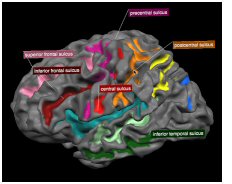
    brain_tutor.jpgBrainTutor is a free-to-download neuroanatomy package from the same people that make the brain scan analysis software BrainVoyager.

    It allows you to rotate and ‘slice through’ a brain scan in 2D and 3D, and click on specific areas to get their names. It’s straightforward to use, and is available for Linux, Mac OSX and Windows.

    Some of the most important buttons are in the bottom right hand corner of the main window but are poorly labelled. They determine whether you are selecting the lobes, sulci (the ‘trenches’) or gyri (the ‘ridges’) when asking for on-screen labels.

    If the surface of the brain looks slightly odd in the BrainTutor software, it’s because BrainVoyager tends to accentuate the sulci during visualisation. This is presumably to enable a better view of the brain activation when it occurs on the surface.

    Link to Brain Tutor software (via Developing Intelligence).

    Secret LSD tests now being compensated

    lsd_soldier.jpgBritish secret intelligence service MI6 has agreed to compensate soldiers who were dosed with LSD without their consent during the 1950s, according to an article in The Guardian.

    Similar experiments were carried out by a number of governments during the 1950s and 60s, in an attempt to create ‘mind control programmes’ and ‘truth drugs’.

    One of the most notorius projects was a CIA run project known as MKULTRA that unethically tested a number of dangerous techniques on unwitting members of the public in an attempt to understand ‘mind control’.

    In one particularly bizarre project, known as Operation Midnight Climax, the CIA created a brothel, spiked the drinks of punters with LSD, and secretly filmed the effects.

    These experiments were largely initiated in reaction to concerns over ‘brain washing’, which American prisoners of war had been subjected to after being captured in Korea.

    One LSD test on British Troops was recorded and is the subject of a well-known video, now widely circulated on the internet.

    The compensation recently paid to ex-British troops echoes a similar payout to ex-patients of the Canadian psychiatric care who had similar unethical experiments conducted upon them, largely under the direction of the one-time head of the World Psychiatric Association Dr Ewan Cameron.

    Link to ‘MI6 pays out over secret LSD mind control tests’ from The Guardian.
    Link to ‘MI6 payouts over secret LSD tests’ from BBC News.
    Link to Wikipedia page on MKULTRA.
    Link to video of LSD testing on British troops.