Deeper into the neuroscience of hypnosis

Photo by Flickr user feastoffools. Click for sourceA new article from Trends in Cognitive Sciences explores how cognitive neuroscientists are becoming increasingly interested in understanding hypnosis and are using it to simulate unusual states of consciousness in the lab.

Hypnosis was typically treated with suspicion by mainstream cognitive science, although an important turning point came when a 2000 study demonstrated that people hypnotised to see colour on grey panels showed activity in the colour perception areas of the brain.

Myths about hypnosis are still common, but it is nothing more than a participant’s willing engagement in a process of suggestion. The hypnotic induction, sterotypically the counting backwards and the ‘you are feeling sleepy’ patter, helps but is not necessary.

Crucially, and for reasons that are still unclear, we all vary in our hypnotisability. This characteristic is known to be more stable than IQ, and normally distributed, like many other psychological traits.

In other words, we can all experience the relaxation and focus, and we can all imagine what the ‘hypnotist’ is suggesting, but only more highly hypnotisable people experience the suggestions as involuntary, as if they’re happening ‘by themselves’.

Recent research has suggested that highly hypnotisable people can disengage the process that looks out for rival demands on our attention, from the process that allows us to focus on which of the competing tasks we need to home in on.

In other words, in highly hypnotisable people, suggestions to experience things contrary to everyday reality may be able to take effect because the normal detect and disentangle mechanism has been temporarily suspended.

Combined with carefully crafted suggestions, this ability allows researchers to simulate certain mental states and experiences in the lab.

For example, hypnotically suggested paralysis, blindness or loss of feeling have been used to simulate the symptoms of ‘hysteria’ or conversion disorder, a condition where neurological symptoms appear without any damage to the nervous system being present.

Other studies have used hypnosis to simulate the feeling that the body is being controlled by outside forces, a common symptom in psychosis, or where a patient thinks their reflection in the mirror is another person, a delusion called mirror misidentification.

And we covered a fantastic study last year, where researchers used hypnosis to simulated psychogenic amnesia, a loss of memory just for old information despite the fact that the patients have none of the brain damage associated with the classic amnesia syndrome.

This new in-depth article covers research attempting to understand hypnosis itself, and science that uses hypnosis as a lab tool, and is a great introduction to the neuroscience research in this developing area.

Link to article.
Link to DOI entry for same.

Full disclosure: the authors of the article are research collaborators and jolly nice chaps to boot.

The morning after the knife before

In the long history of outrageous drinking stories, this has got to be one of the best.

The Emergency Medical Journal has a case study of a man who woke up in hospital after being admitted for alcohol poisoning. He couldn’t remember what happened the night before but when his hangover didn’t clear a precautionary brain scan revealed a knife blade embedded in his temporal lobe.

A left handed, 22‚ÄÖyear old man was brought to the hospital by friends at 0200 because of alcohol intoxication. Events preceding the admission and motivation for the patient to go to the hospital were unclear. The patient’s relatives confessed to a binge drinking of rum and beer, and then being moved suddenly, probably to avoid police control…

The patient woke up 8‚ÄÖhours after admission, complaining of severe headache covering the whole head and gradually increasing in intensity… Surprisingly, brain computed tomography revealed a right temporal haematoma 34‚ÄÖmm in diameter, with a knife blade that had entered from the temporal fossa and was deeply retained in the right temporal lobe (fig 1).

The foreign body was surgically withdrawn, and postoperative recovery was uneventful. After awakening from surgery, the patient could not remember involvement in an altercation, but witnesses retrospectively confirmed that he was attacked with a knife after drinking with his assailant.

There’s also a lovely sentence in the paper which has an apt typo: “Vigorous stimulations only induced growling and repelling movements of the harms and legs”.

Link to ‘an unusual cause for headache following massive alcohol intake’.

Exploding head syndrome

I’ve just found an article with two interesting cases of ‘exploding head syndrome’ – a medical condition where affected people spontaneously hear an exceptionally loud explosion-like noise.

The condition is relatively harmless, causing people only to be startled, and it doesn’t seem linked to seizure activity or epilepsy. Owing to the fact it’s both benign and uncommon, it’s not been widely studied and so its cause remains a mystery.

Case 1
A 48-year-old man was seen in December 2006. For the past several months about three to four times a month, he had been having attacks of a peculiar sensation in the head likened to the noise of an exploding bomb only at night while going off to sleep. The ‘explosion’ would wake him up and disappear completely the moment he woke up.

There was no headache and no associated symptoms such as nausea, vomiting or any visual sensation. For the past 3 months, the frequency of these sensations had increased and had been occurring nearly daily at the time of consultation. The noise occurred only once during every night, after which he could go off to sleep. His past medical history had been unremarkable and he had never suffered from any significant headache problem. General physical and neurological examination had been unremarkable. Magnetic resonance imaging (MRI) of brain with contrast had been normal. He was prescribed Flunarazine 10 mg daily. At 6 months’ follow-up he had much improved and noticed the exploding head symptom only on two occasions.

Case 2
A 65-year-old man was seen in February 2007. He was hypertensive and diabetic (both well controlled on oral medication) and had been having infrequent attacks of International Headache Society migraine headache (every 2–4 months) without aura since the age of 15 years. For the past 4 months prior to consultation, every 2–3 weeks, he had been awakened while going off to sleep only during taking a daytime nap by a sudden exploding (like a bomb bursting) noise in his head lasting for only few moments.

This noise was always accompanied with jerky elevation of his right arm and a queer sensation in the right side of his chest (not arm) and again lasting only momentarily. He felt quite well on waking up and could go off to sleep again. These were never accompanied by any visual flashes and never occurred during sleep at night. These sensations were very different from his migraine headaches, which lasted for several hours and the noises were not accompanied by any nausea or vomiting.

Physical examination was normal and his blood presswure in the clinic was 136/80 mmHg. He had already had a MRI of brain with contrast, MR angiography of brain and two interictal sleep EEG recordings performed before consultation with the author, all of which were normal. A video EEG with daytime sleep recording was performed, but no event could be captured.

Link to article with case studies.
Link to PubMed entry for same.

Extreme altitude climbs and the Sherpa brain

It’s now well known that high altitude mountain climbing damages the brain and causes a marked reduction in mental functioning.

I naively assumed this was true for everyone but I just found an intriguing 1996 study that compared brain function of lowland mountain climbers and Nepalese Sherpas after ascent to high altitude, which found that the Sherpas suffer few of these neurological problems.

Are Himalayan Sherpas better protected against brain damage associated with extreme altitude climbs?

Garrido E, Segura R, Capdevila A, Pujol J, Javierre C, Ventura JL.

Clin Sci (Lond). 1996 Jan;90(1):81-5.

1. The potential risk of brain damage when low-landers attempt to climb the highest summits is a well-known fact. However, very little is known about what occurs to Himalayan natives, perfectly adapted to high altitude, when performing the same type of activity.

2. Taking into account their long-life climbing experience at extreme altitudes, we examined seven of the most recognized Sherpas with the aim of performing a comprehensive neurological evaluation based on medical history, physical examination and magnetic resonance brain imaging. We compared them with one group of 21 lowland elite climbers who had ascended to altitudes of over 8000 m, and another control group of 21 healthy individuals who had never been exposed to high altitude.

3. While all of the lowland climbers presented psychoneurological symptoms during or after the expeditions, and 13 of them (61%) showed magnetic resonance abnormalities (signs of mild cortical atrophy and/or periventricular high-intensity signal areas in the white matter), only one Sherpa (14%) showed similar changes in the scans, presenting neurological symptoms at extreme altitude. The neurological examination was normal in all three groups, and no neuroimaging abnormalities were detected in the control group.

4. The significant differences, in both clinical and neuroimaging terms, suggest that Sherpa highlanders have better brain protection when exposed to extreme altitude. Although the key to protection against cerebral hypoxia cannot be established, it is possible that an increase in the usually short period of acclimatization could minimize brain damage in those low-landers who attempt the highest summits without supplementary oxygen.

Link to study of neurology of lowland climbers and Sherpas.

A Trance of Pleasure

Photo by Flickr user ubiquity_zh. Click for sourceA 2003 study in Epilepsy and Behavior has some descriptions of the ecstatic seizures experienced by some patients with epilepsy.

They include intense erotic and spiritual experiences, feelings of become close to and blending with other people, and some sensations that couldn’t be fully captured in words.

I’ve put some of the descriptions below because they sound absolutely wonderful:

Patient 1
The first seizure occurred during a concert when he was a teenager. He remembers perceiving short moments of an indefinable feeling. Such episodes recurred and a few months later evolved into a GTC [generalized tonic–clonic seizure]. He characterizes these sensations as “a trance of pleasure.” “It is like an emotional wave striking me again and again. I feel compelled to obey a sort of phenomenon. These sensations are outside the spectrum of what I ever have experienced outside a seizure.” He also describes cold shivering, increased muscle tension, and a delicious taste, and he swallows repeatedly. He enjoys the sensations and is absorbed in them in a way that he can barely hear when spoken to. When in a particular, relaxed mood, he can sometimes induce seizures by “opening up mentally” and contracting muscles. He denies any religious aspects of the symptoms. “It’s the phenomenon, the feeling, the fit taking control.” It lasts a few minutes and afterward he is tired with difficulties expressing himself for about 1 hour.

Patient 6
This man has a multifaceted symptomatology and a tendency to interpret bodily sensations as supernatural phenomena. Nevertheless, from the beginning of his forties, he experienced distinct, stereotypical attacks with a “change of concept of the surrounding world.” He reports an “oscillating erotic sensation, like twinkling polar light” in his pelvic region and down the inside of his thighs. This is described as different from sexual excitement, more like “an erogenous charge of the skin.” He may also have a clairvoyant feeling of a “telepathic contact with a divine power.” These sensations are of short duration and may be accompanied by faintness and followed by drowsiness. With carbamazepine treatment, the frequency of these attacks has been considerably reduced.

Patient 11
The attacks started in his first school year. The experiences are beyond what can be described in words. “I can sense the colours red and orange without seeing them. The feeling has an erotic aspect. It starts in the stomach and spreads upwards. It is pleasant, but not similar to ordinary joy. It is like an explosion.” In the close presence of another person, he can feel a sort of peculiar unification. An intense déjà vu sensation, a queer taste, and “gooseflesh” are also components of the seizures. As a child he was surprised that his friends denied having similar feelings, and he learned to keep them to himself. Sometimes these attacks evolved into CPSs with reduced consciousness and complex automatisms and afterward he had transient difficulties speaking. Before the diagnosis of epilepsy was made in his late teens, he was referred to a psychiatrist. A right-sided temporal lobe calcification was diagnosed by computed tomography at about 30 years, but he refused surgery. At 42, an expansion in the same region was found by MRI, and he was operated for an anaplastic oligodendroglioma. He was seizure-free for 6 years until recurrence of the tumor.

One of the striking things about epilepsy is how different each person’s experience of having a seizure can be.

While it is stereotypically assumed to be a negative experience, some aspects can be remarkably beautiful.

The Russian author Dostoyevsky famously said of his epilepsy “I would experience such joy as would be inconceivable in ordinary life – such joy that no one else could have any notion of. I would feel the most complete harmony in myself and in the whole world and this feeling was so strong and sweet that for a few seconds of such bliss I would give ten or more years of my life, even my whole life perhaps.”

There are several more case descriptions in the article, all of which have some aspect which touch at least the edge of ecstasy, if not the very heart of the experience.

Link to article.
Link to PubMed entry for same.

Dodging the border agency of the brain

Photo from Wikipedia. Click for sourceI just noticed that neurotechnology analyst Zack Lynch has a forthcoming article in Epilepsy and Behavior on the latest developments in the commercial brain science field. Avid neuroscience fans may be familiar with most of it but the section on new technologies to cross the blood-brain barrier was eye-opening.

The blood-brain barrier (BBB) is a sieve-like border crossing that allows only certain molecules to pass from the blood into the brain.

It’s remarkably restrictive and many molecules are just too big to get past, meaning that many drugs that could affect the brain are virtually useless, simply because they can’t cross the border.

This has led neuroscientists to think of ways of smuggling, tunnelling and sneaking this these molecules past the barrier, and Lynch’s article lists some of the latest technologies which aim to jump the fence.

• Implantable devices: Implantable pumps bypass the blood–brain barrier (BBB) and deliver highly accurate amounts of drugs to specific sites in the brain or spinal cord.

• Expression systems: A French company is circumventing the BBB using encapsulated cell technology (ECT), a polymer implant containing cells that provide continuous, long-term release of the therapeutic protein to the brain or eye.

• Receptor-mediated transport: Receptors that transport nutrients to the brain from the blood can be tricked into transporting therapeutic chemicals, peptides, and proteins across the BBB. Insulin, transferrin, and lipoproteins, for example, cross the BBB by facilitated transport, and can be combined with therapeutic proteins or other molecules to promote access to the brain.

• Cell-penetrating peptides: During the past decade, several arginine-rich peptides have been described, such as SynB vectors, which allow for intracellular delivery and BBB transport. The mechanism for this transport is unknown. A Swiss company is using cell-penetrating peptides to develop treatments for stroke and myocardial infarction.

• Focused ultrasound: Some research shows that focused ultrasound can temporarily open the BBB in a targeted area for a window of time. A seed stage company is working to commercialize this technology and improve it for use in humans.

• Nanoparticle formulations: Nanoparticle formulations refer to therapeutics encapsulated in nanoscale particles that can pass the BBB. Although there is great interest in using nanotechnology to improve neuropharmaceutical delivery to the brain, it will take some time to overcome challenges of this platform, including the need for intravenous delivery, manufacturing, and clearance by the liver.

Link to summary of article.

The beautiful baby brain

Jonah Lehrer has an excellent piece in today’s Boston Globe about how babies’ brains develop and what psychologists are starting to understand about the infant mind.

It’s largely riffing on the work of Alison Gopnik, one of the world’s leading developmental psychologists, who has long argued that babies might be more conscious than adults and that we learn to filter the world and mentally manage its initial chaos.

While this less focused form of attention makes it more difficult to stay on task – preschoolers are easily distracted – it also comes with certain advantages. In many circumstances, the lantern mode of attention can actually lead to improvements in memory, especially when it comes to recalling information that seemed incidental at the time.

Consider this memory task designed by John Hagen, a developmental psychologist at the University of Michigan. A child is given a deck of cards and shown two cards at a time. The child is told to remember the card on the right and to ignore the card on the left. Not surprisingly, older children and adults are much better at remembering the cards they were told to focus on, since they’re able to direct their attention. However, young children are often better at remembering the cards on the left, which they were supposed to ignore. The lantern casts its light everywhere.

I’m a bit sceptical of one bit of the article though, where it claims that babies have more neurons than adults, as researchers have only very recently attempted to make this estimate and, in fact, found that babies and adults have about the same in the cortex, which makes up the vast majority of the brain.

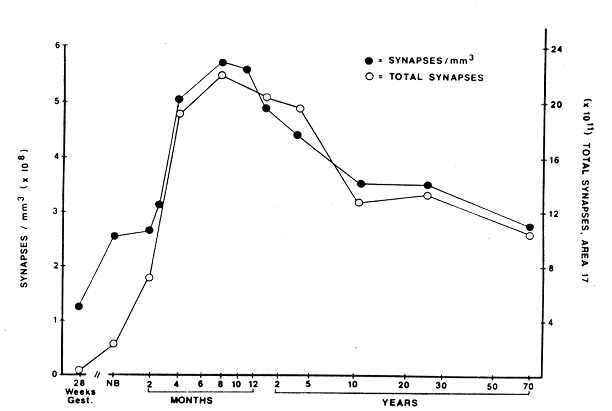
In terms of synapses, connections between neurons, this varies on the age of the infant. For example, have a look at this graph of synapse density as we grow, taken from a study of the human cortex.

Newborns start with fewer synapses than adults but this number rockets, so by six months of age we have approximately twice as many connections. This tails off as the brain prunes connections on a ‘use it or lose it’ basis.

I’m always slightly awestruck whenever I view that graph as it is a vivid illustration of the incredibly rapid changes changes that take place as we grow and learn to make sense of the world.

It’s this same sense of awe that the Boston Globe manages to capture as it explains how understanding the baby’s brain can help us make sense of the adult mind.

Link to Boston Globe article ‘Inside the baby mind’.

The risks of cognitive enchantment

The New Yorker has a fantastic in-depth article about ‘cognitive enhancement’ that talks to some of the neuroscientists studying the effects and some of the mind tweakers who regularly pop pills to give themselves an edge.

One of the issues it touches on is whether cognitive enhancers really ‘enhance’ people, and there’s good evidence that for the highest achievers, the pills might not be of much benefit.

Even worse, it’s also likely that the amphetamine-based drugs (Ritalin, Adderall) could actually impair your performance even though you might feel as if you’ve had a mental boost.

Amphetamine has the effect of increasing focus, confidence and giving a euphoric feeling. Although the effects are less marked in the slow release amphetamines used for ADHD and appropriated for illicit mind tweaking, the effect is certainly still there.

What we do know, however, is that people with certain genotypes actually show a decrease in working memory performance when they take amphetamine.

And it turns out that these are the people most likely to already be at the high end of mental performance. This is from a classic study on the effect:

Amphetamine enhanced the efficiency of prefrontal cortex function assayed with functional MRI during a working memory task in subjects with the high enzyme activity val/val genotype [of the COMT gene], who presumably have relatively less prefrontal synaptic dopamine, at all levels of task difficulty.

In contrast, in subjects with the low activity met/met genotype who tend to have superior baseline prefrontal function, the drug had no effect on cortical efficiency at low-to-moderate working memory load and caused deterioration at high working memory load

In other words, it’s possible that high achievers might be popping stimulants, feeling like it boosts their performance, when in fact, it’s doing exactly the opposite.

The article explores more than just this area though, and is incredibly wide-ranging, looking at the neuroscience, the underground use of the drugs, legal aspects, new and current compounds, and so on.

It’s also one of the most interesting articles I’ve read on the subject for a while, which, for an area which attracts of lot of attention, has got to be a good thing.

Link to ‘The underground world of ‚Äúneuroenhancing‚Äù drugs’.

Seized by the anti-storm

Newsweek has an excellent article on the neuroscience and personal impact of epilepsy. It’s well-researched, gripping in parts and bang up-to-date as it takes us through how neurologists tackle the seizure-prone brain.

I was particularly impressed by the following section as it avoids the common clich√© of the epileptic ‘brain storm’ because, as we’ve discussed before on Mind Hacks, a seizure is not a storm of random brain activity.

In fact, it’s completely the opposite. During a seizure neurons become super-synchronised, pulsing together, so they can’t do their normal job. In effect, it’s an anti-storm.

Conceptually, the job of the cardiologist is straightforward: he needs to restore a damaged heart to its normal rhythm. But epilepsy is the opposite. A normal brain is governed by chaos; neurons fire unpredictably, following laws no computer, let alone neurologist, could hope to understand, even if they can recognize it on an EEG. It is what we call consciousness, perhaps the most mathematically complex phenomenon in the universe.

The definition of a seizure is the absence of chaos, supplanted by a simple rhythmic pattern that carries almost no information. It may arise locally (a “partial” seizure), perhaps at the site of an old injury, a tumor or a structural malformation. A network of neurons begin firing in unison, enlisting their fellows in a synchronous wave that ripples across the brain.

Or it may begin everywhere at once (“generalized” epilepsy), with an imbalance of ions across the cell membrane, usually the result of an inherited mutation. At a chemical signal, whose origin is still a mystery, billions of neurons drop the mundane business of running the body and join in a primitive drumbeat, drowning out the murmur of consciousness. And so in contrast to the cardiologist, the epilepsy doctor must attempt to restore not order, but chaos.

The article is very much epilepsy from the medical perspective, but it is probably the single best mainstream piece I’ve read that attempts to tackle this area.

If you only read a handful of epilepsy articles in your life, make this one of them. Well done Newsweek.

Link to Newsweek article ‘In the Grip of the Unknown’.

Hemispheres of influence

Discover Magazine has an interesting Carl Zimmer article on one of the most intriguing questions in neuroscience – why do we have two cortical hemispheres? And why are they not quite the same?

It turns out that the ‘brain of two halves’ is incredibly common in the animal kingdom and that many creatures also show the behavioural lateralisation that we most readily see in humans as someone being left or right handed.

But it’s no entirely sure why we, or indeed, or animal compatriots, have evolved this way, although various theories are kicking around:

David Stark of Harvard Medical School recently found additional clues about lateralization in his studies of 112 different regions in the brains of volunteers. He and his collaborators discovered that the front portions of the brain are generally less tightly synchronized across the hemispheres than are the ones in the back. It may be no coincidence that the highly synchronized back regions handle basic functions like seeing.

To observe the world, it helps to have unified vision. At the front of the hemispheres, in contrast, we weave together streams of thought to produce complex, long-term plans for the future. It makes sense that these areas of the brain would be more free to drift apart from their mirror-image partners.

Zimmer goes on to puncture the myth of ‘left brained’ and ‘right brained’ people, or indeed, thinking styles, erroneously labelled with these pseudoscientific terms.

While certain cognitive styles have been correlated to greater activation in the left or right hemisphere, to describe a whole class of problems of thinking methods like this is nonsensical because the two hemispheres of the brain work together.

It’s like claiming someone is a good cook solely because they come from Italy. The generalisation is so broad it just doesn’t apply to individual people or situations.

Anyway, the Discover article is an excellent whistle-stop tour through the curious world of brain lateralisation.

Link to Discover on the brain of two hemispheres (via @mocost).

Involuntary masturbation in alien hand syndrome

Photo by Flickr user Kaptain Kobold. Click fr sourceI’ve just found this fascinating case study in American Journal of Physical Medicine and Rehabilitation about a man who lost conscious control over one of his hands after brain injury and suffered involuntary public masturbation episodes as a result.

Involuntary masturbation as a manifestation of stroke-related alien hand syndrome

Ong Hai BG, Odderson

Am J Phys Med Rehabil. 2000 Jul-Aug;79(4):395-8.

Alien hand syndrome is a perplexing and uncommon clinical diagnosis. We report an unusual manifestation of alien hand syndrome in a 73-yr-old man with a right anterior cerebral artery infarct affecting the right medial frontal cortex and the anterior portion of the corpus callosum. We conclude that alien hand syndrome should be considered in patients who present with a feeling of alienation of one or both upper limbs accompanied by complex purposeful involuntary movement.

We tend to think of the cognitive impairments after brain injury as the most disabling – things like loss of memory or speech or language impairment, but we often neglect what we might call social impairments.

Especially when the effect is embarrassing, these can have just as strong an impact because many people massively restrict their lives to prevent causing social discomfort to themselves or others.

Link to PubMed entry for study.

The unclear boundary between human and robot

I am pleased to see a letter in this week’s Nature that shows that I’m not the only neuroscientist concerned about the coming robot war. Brain researchers Olaf Blanke and Jane Aspell wrote in to warn about the use of brain-machine interfaces, not to control machines with thoughts, but to control thoughts with machines.

Imagine if insights from the field of cortical prosthetics in human and non-human primates were combined with research on bodily self-consciousness in humans. Signals recorded by multi-electrodes implanted in the motor cortex can already be used to control robotic arms and legs. Cognitive cortical prosthetics will allow the use of other cortical signals and regions for prosthesis control. Several research groups are investigating indications that the conscious experience of being in a body can be experimentally manipulated.

The frontal and temporoparietal signals that seem to be involved encode fundamental aspects of the self, such as where humans experience themselves to be in space and which body they identify with (O. Blanke and T. Metzinger Trends Cogn. Sci. 13, 7‚Äì13; 2009). If research on cortical prosthetics and on the bodily self were applied to humans using brain-controlled prosthetic devices, there might be no clear answer to Clausen’s question: which of them is responsible for involuntary acts?

It may sound like science fiction, but if human brain regions involved in bodily self-consciousness were to be monitored and manipulated online via a machine, then not only will the boundary between user and robot become unclear, but human identity may change, as such bodily signals are crucial for the self and the ‘I’ of conscious experience. Such consequences differ from those outlined by Clausen for deep brain stimulation and treatment with psychoactive drugs.

The letter is a follow-up to a recent Nature piece on potential new ethical issues raised by the development of implantable brain technology.

Unfortunately, these sort of in-house scientific debates rarely do much to raise the public consciousness about the importance of such issues.

However, I have high hopes for the future. Not least because a new film in the Terminator documentary series is soon to be released.

Link to letter in Nature.

When dreams come to life

Photo by Flickr user Pensiero. Click for sourceIn C.S. Lewis’ Narnia novel The Voyage of the Dawn Treader the heroes find a man stranded on an island where dreams come true. They initially express delight but the man rages “Fools!” “Do you hear what I say? This is where dreams – dreams, do you understand? – come to life, come real. Not daydreams: dreams.”

But dreams can come to life and the effect is no less fantastical. In REM sleep behaviour disorder (RBD), normal sleep paralysis breaks down and sleepers act out their dreams – giving observers a remarkable insight into the dreaming mind.

An article recently published in Neurology charted the range of sleep behaviours seen in people with neurological disturbances such as narcolepsy, Parkinson’s disease or other types of dementia, all of which can trigger the problem.

Incidental cases of nonviolent behaviors during RBD included masturbating-like behavior and coitus-like pelvic thrusting, mimicking eating and drinking, urinating and defecating, displaying pleasant behaviors (laughing, singing, dancing, whistling, smoking a fictive cigarette, clapping and gesturing “thumbs up”), greeting, flying, building a stair, dealing textiles, inspecting the army, searching a treasure, and giving lessons. Speeches were mumbled or contained logical sentences with normal prosody [voice tone, rhythm and stress].

The paper also contains two case studies which describe, in detail, exactly what each patient was doing when they were acting out their dreams. This is from the description of ‘Patient 2’:

These behaviors, which occurred with eyes closed, were complex, various, and usually accompanied with sentences resembling a teacher with children (first sequence) or a captain inspecting his troop (second sequence): “(Professorial) Can we all return to our seats! (pause) (Overbearing) What do you do, standing there in the middle? (pause) Remove your finger away from the switch! (pause) Well, if that’s so, I’ll take the numbers. (Ironic) And . . . late! (pause). (Professorial) Get back to your seats. I’m going to start.”

Mumbles for 6 minutes. Then: “(bossy) Raise your hands, raise your hands, raise your hands, I said raise! I didn’t say to pull away! I said: raise your hands!” Here the patient quickly raised his left arm and waved his hand it as if he were showing something. “(Bossy and rhythmic) Halt! (pause) Halt! (pause) Halt!” Three minutes later, he shouted “(Bossy, like in a military parade) Attention! Gentleman, please, attention! (pause) Halt, halt, I said! (pause) Halt, I said!”

This study specifically focused on the less researched non-violent sleep behaviours, as the disorder is more typically associated with acting out aggressive dreams.

This is possibly because the disturbances that cause the disorder also affect the content of the dreams.

An earlier study found that patients with the disorder reported having more aggressive dreams, even though they were not more aggressive in waking life.

It’s a fascinating article and worth reading in full as it contains many ‘wow, that’s amazing’ moments, both for the scientific insights, and the windows into the mental life of sleep.

Link to Neurology article on sleep behaviours.
Link to PubMed entry for same.

Imaging the transgendered brain

For the first time, the brain structure of male-to-female transsexuals has been investigated in living individuals using MRI brain scans, helping to fuel the debate over the possible neural basis of gender identity.

The scientific article, shortly to appear in the neuroscience journal NeuroImage, used MRI brain scans and a technique called voxel based morphometry to compare grey matter in a group of male-to-female transexuals to groups of males and females who have never had gender-identity concerns.

This is not the first time that brain structure has been compared in this way, but earlier studies had been based on post-mortem comparisons. These three studies had found that certain areas in male-to-female transsexuals more commonly resembled the equivalent area in females than males.

This has led some researchers to go as far as suggesting that perhaps the differences are present from birth and that gender-identity difficulties could result from the body and brain following different paths as the developing foetus begins to develop into a specific sex.

However, one difficulty is that all the transgender people examined in these post-mortem studies had been on oestrogen treatment to feminize their bodies, and it hasn’t been clear whether the differences were due to the effect of this hormone rather than something present before.

This new study, led by neuroscientist Eileen Luders, specifically recruited male-to-female transsexuals who had never taken oestrogen and, being in living people, wasn’t affected by whatever led to the person’s death.

In contrast to previous investigations, this new study found that male-to-female transsexuals grey-matter was similar in most areas of the brain to the male rather than female comparison group.

Except, that is, for one area, the putamen, a deep brain structure that forms part of the basal ganglia – known for its wide range of functions and connections to the frontal lobes and action control areas.

Because we know so little about the neuroscience of self-image and gender-identity it’s almost impossible to draw any conclusions for the fact that this specific area seems more ‘feminine’, or that the majority of the other areas seem more ‘masculine’ in terms of size.

What this study does do, however, is add to the increasing evidence that there are some detectable neurological differences in the brains of transgendered people. We’re just not in a position to say much about the significance of this yet.

Link to PubMed entry for ‘in press’ paper.

A life’s journey in neuroscience

New Scientist has an excellent cover article on ‘The five ages of the brain’, looking at how the brain changes as we grow and how these transformations are reflected in our lives.

It breaks the life span down into ‘five ages’, with a short article for each – tackling gestation, childhood, adolescence, adulthood and old age.

Each gives a concise introduction to some of the latest findings on how the brain differs in each time period, although for a slight counter-point, I would recommend a recent edition of ABC Radio National’s All in the Mind.

The programme takes a sceptical look at the emerging neuroscience of adolescence, largely based on the fact that adolescence as a distinct developmental stage is a relatively recent cultural invention of the Western world.

Psychologist Robert Epstein argues that the differences in the teen brain are relatively minor, and that the stereotype of the ‘teen in turmoil’ is not a biological fact of brain development, but a result of the cultural pressures put upon adolescents.

The NewSci collection and the All In the Mind programme complement each other nicely and tackle some of the current hot issues in developmental neuroscience.

Link to NewSci ‘Five Ages of the Brain’ special.
Link to AITM on ‘The modern teenager: myth or marvel?’

Rendered frantic, crazy by unbroken concentration

Advances in the History of Psychology has just alerted me to a fascinating short article on the work of the influential 18th-century physician Samuel Tissot, who wrote a book arguing that concentrating on books for too long damaged the mind.

The 18th century was when books were becoming cheap enough to be widely available to the middle classes and it’s interesting that this new cultural development produced a similar pseudo-medical concern about damage to the mind that we often hear today, but in a completely different direction.

While modern day technological doom-sayers suggest that technology damages the mind because it interrupts concentration, 18th century technological doom-sayers suggested that reading damaged the mind because it required too much concentration.

Neither have an evidence base, but I maintain a morbid interest in medicalised concerns about new technology and cultural innovations, which often take the same basic form but cite a cause which is always curiously in line with the authors’ prejudices.

It turns out Tissot, like many of this medical contemporaries, was also obsessed with masturbation, which he cited as the cause of madness and a host of other psychological problems.

Catholic church aside, it seems a ridiculous view to us now, but it was widely held by some of the most prominent and influential medical men of the time.

Link to Guardian ‘Beware: studying can make you ill’.
Link to AHP on ‘Read Till You‚Äôre Crazy’.